Research problem
Missing EV charging records caused by communication or equipment failures can substantially degrade charging-load forecasts.
The paper treats data quality as a first-class component of smart-building and EV load forecasting.
Authors: Fahim, Belal Mahmud; Akbar, Mohammad Kaosain; Amayri, Manar
Journal: Building Simulation, 2025, volume 18, issue 4, pages 897–922
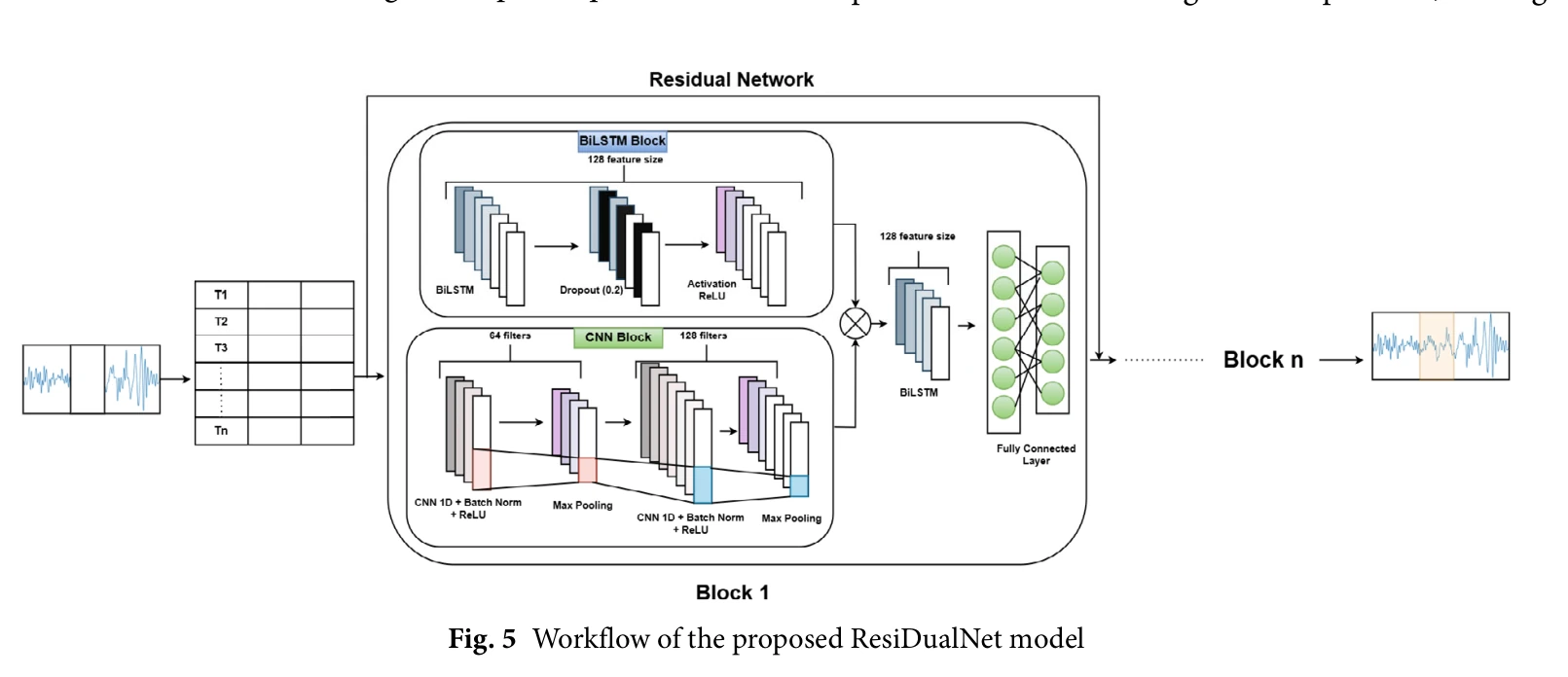
Electric vehicles (EVs) are a sustainable mode of transportation, significantly reducing greenhouse gas emissions. The development of EV charging stations is crucial for supporting the growing number of EVs and integrating them into smart grid infrastructure. Efficient use of these stations requires optimized energy management and accurate forecasting of EV charging behaviors. However, forecasting accuracy is often hindered by missing data due to connectivity issues and equipment failures. To address these challenges, this study introduces a novel data imputation method ResiDualNet (Residual Dual BiLSTM-CNN Path Network), which is a residual sequence-to-sequence technique for imputing missing EV charging data. This model effectively captures underlying temporal and long-term dependencies, demonstrating strong performance across various scenarios. We compare our proposed model with two commonly used imputation methods KNN and Mean Imputation and one generative model, Generative Adversarial Network (GAN), across four different EV charging datasets. Experimental results demonstrate that our model significantly outperforms the others, showing an average improvement of 82% in terms of root mean squared error (RMSE) across all datasets. To further assess the effectiveness of our imputation model, we utilize three cutting-edge and newly introduced forecasting models: Bidirectional Long Short-Term Memory (BiLSTM), Mogrifier LSTM, and Sample Convolution and Interaction Network (SCINet) to predict EV charging load. The results indicate that SCINet outperforms the other forecasting techniques. Moreover, for SCINet, the dataset imputed by our proposed model performs second best after the real dataset, confirming the effectiveness of our imputation approach in improving forecasting accuracy for EV charging data. The complete source code is provided in the following repository: https://github.com/fffahim/ResiDualNet.git
Missing EV charging records caused by communication or equipment failures can substantially degrade charging-load forecasts.
ResiDualNet uses a residual dual BiLSTM-CNN sequence-to-sequence architecture for imputation and is evaluated before several downstream forecasting models.
Across four charging datasets, the reported RMSE improvement over comparison imputation methods averages 82%; SCINet performs best among the tested forecasting models.
The paper treats data quality as a first-class component of smart-building and EV load forecasting.
Fahim, Belal Mahmud; Akbar, Mohammad Kaosain; Amayri, Manar. ResiDualNet: A novel electric vehicle charging data imputation technique to enhance load forecasting accuracy. Building Simulation , 2025, 18, 897–922. https://doi.org/10.1007/s12273-025-1236-8
Use the DOI record as the primary source for formal scholarly citation.