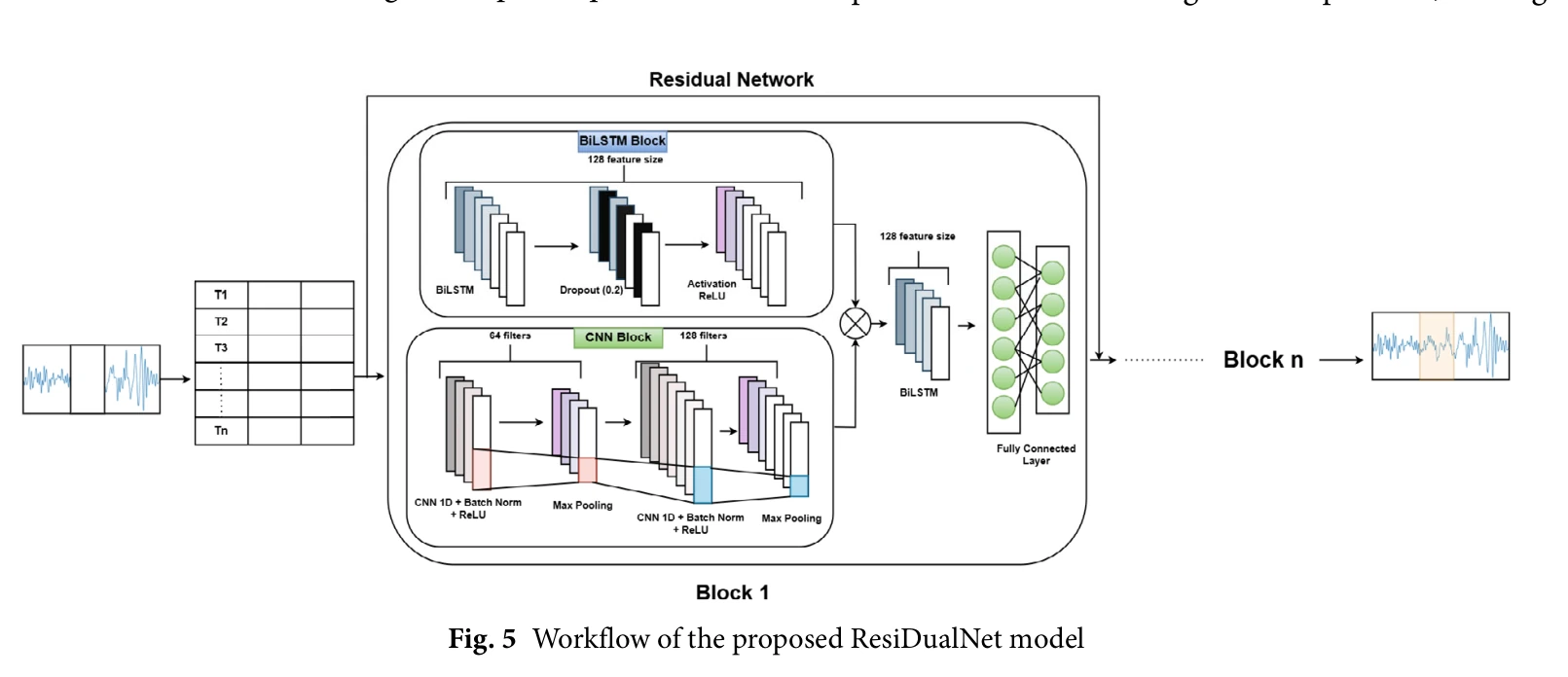
ResiDualNet: A novel electric vehicle charging data imputation technique to enhance load forecasting accuracy
The paper treats data quality as a first-class component of smart-building and EV load forecasting.
The selected papers address uncertainty at three levels: missing EV charging data, uncertain day-ahead market and demand conditions, and uncertain building design loads. Their methods span residual sequence models, distributionally robust optimization, and graph convolutional networks.
| Paper | Research problem | Method | Reported evidence |
|---|---|---|---|
| Fahim et al. (2025) | Missing EV charging records caused by communication or equipment failures can substantially degrade charging-load forecasts. | ResiDualNet uses a residual dual BiLSTM-CNN sequence-to-sequence architecture for imputation and is evaluated before several downstream forecasting models. | Across four charging datasets, the reported RMSE improvement over comparison imputation methods averages 82%; SCINet performs best among the tested forecasting models. |
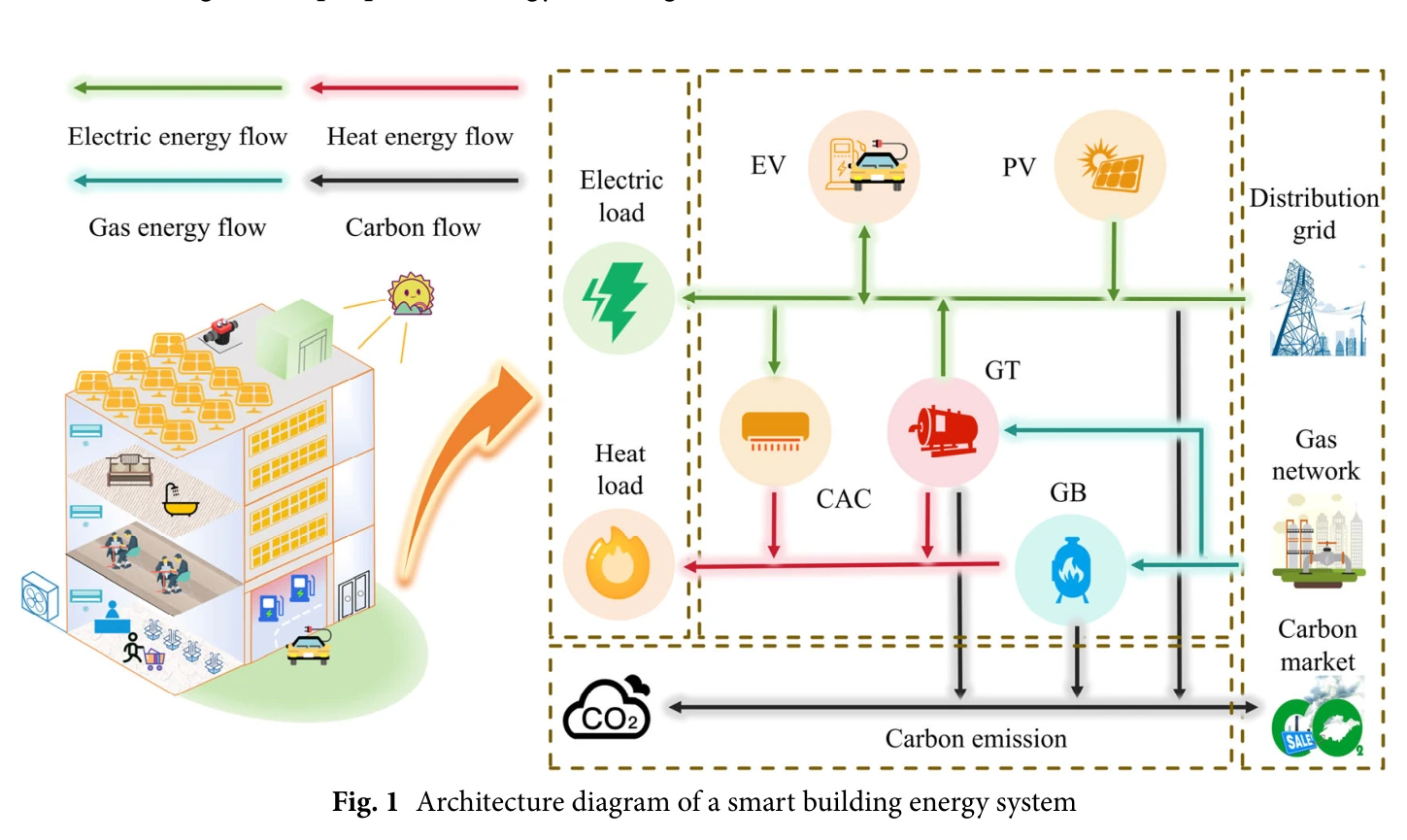
| Zhao et al. (2025) | Day-ahead scheduling of buildings and EVs must manage demand response, thermal inertia, uncertainty, and carbon-related objectives. | The study formulates price-based demand response and thermal storage, then solves a Wasserstein distributionally robust Stackelberg game through KKT and duality transformations. | The proposed strategy reduces total building-energy-system operating cost by 26.37% in the reported simulations and smooths the load curve. |
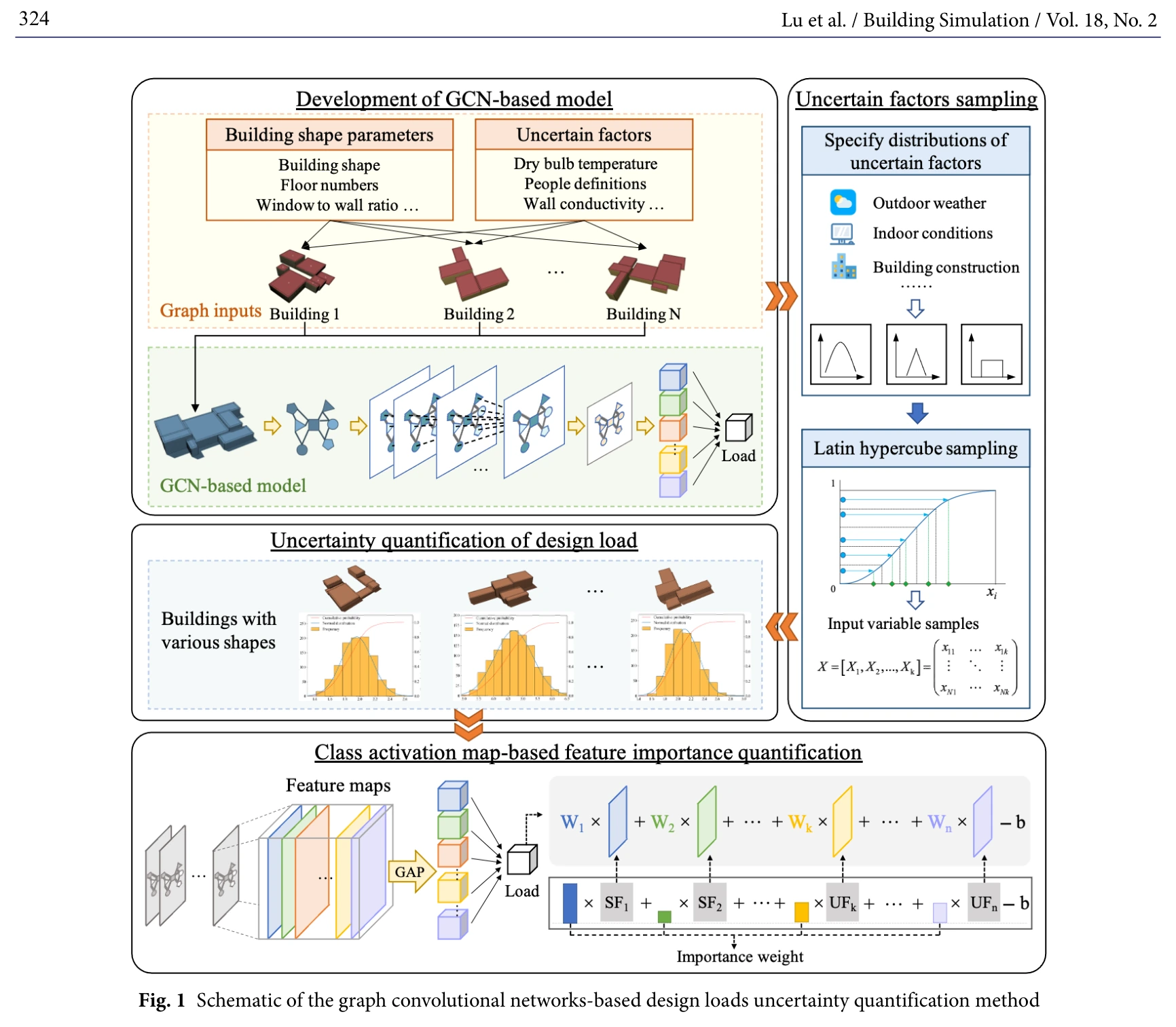
| Lu et al. (2025) | Data-driven design-load models may not generalize across buildings with diverse and complex geometries. | Buildings are represented as graphs of blocks, nodes, and spatial edges; a GCN predicts uncertainty statistics and a class-activation map identifies influential uncertain factors. | Reported MAPE is below 6% for cooling-load statistics and below 4% for heating-load statistics, while computation for a 20-floor building drops from 331 hours to 30 seconds relative to the physics-based workflow. |
The paper treats data quality as a first-class component of smart-building and EV load forecasting.
The work links building thermal flexibility, EV aggregation, market interaction, and distributionally robust optimization.
The paper applies graph representation learning to fast, geometry-aware uncertainty quantification at design stage.