Research problem
Chiller models trained on sparse operating data may extrapolate poorly and provide limited physical interpretability.
The work shifts physics-informed learning from loss-only constraints toward explicit physics-based information flow inside the network.
Authors: Fang, Junjian; Yan, Chengchu; Lu, Weidong; Shi, Jingfeng; Xu, Lei; Hu, Kai; Ji, Yuanhui; Zhuang, Chaoqun
Journal: Building Simulation, 2025, volume 18, issue 7, pages 1877–1901
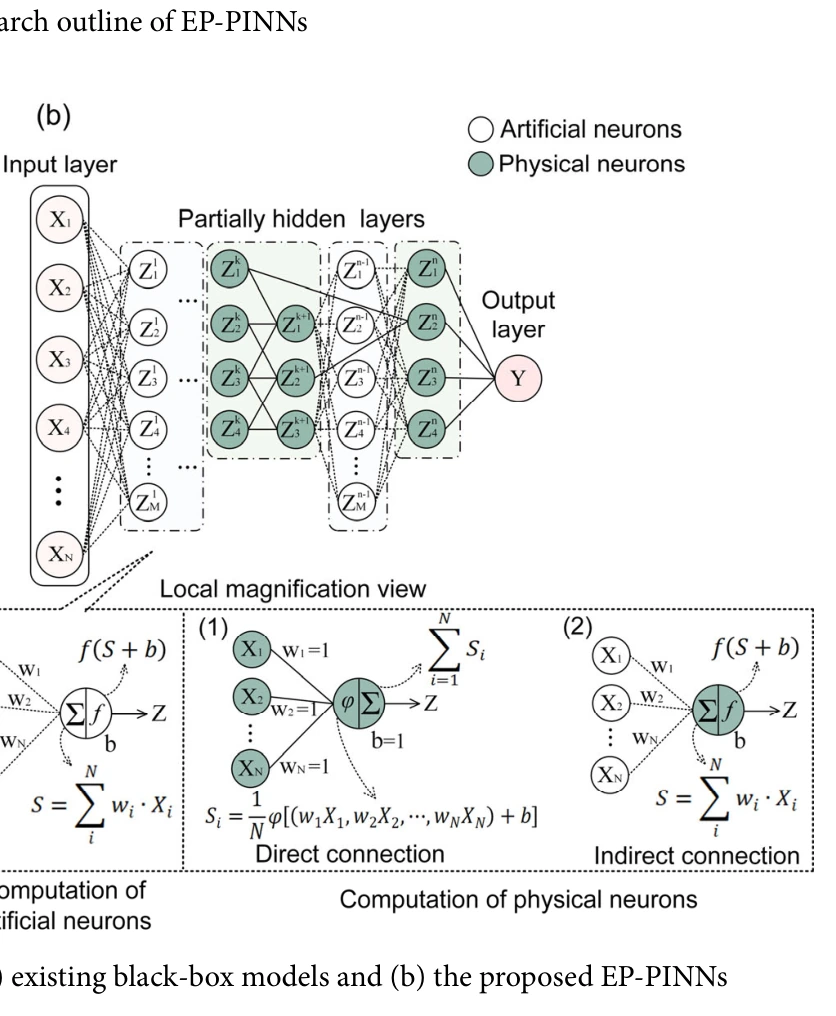
Accurate chiller performance prediction is crucial for improving the energy efficiency of heating, ventilation, and air conditioning (HVAC) systems. Data-driven models commonly used to enhance chiller performance often rely on sparse data collected under restricted conditions. These models must extrapolate beyond their training data in practical applications, but they generally lack the generalization capability needed for reliable predictions outside their training range. Additionally, their limited interpretability hampers understanding of the physical processes affecting chiller performance, complicating fault identification and performance optimization. To address these issues, this study embeds physical neurons in physics-informed neural networks (EP-PINNs) to enhance chiller performance prediction. By leveraging prior physical knowledge, physical neurons are introduced and embedded into the neural network, forming a neural network architecture with intrinsic physics-based information flow. Simultaneously, simplified physical loss terms are used to guide the training process. The proposed EP-PINNs were applied to predict the performance of four different chillers, and the results demonstrated their high prediction accuracy. Compared to data-driven models, the EP-PINNs exhibited significantly improved generalization capability and interpretability. These advantages highlight the practical value of EP-PINNs in HVAC equipment performance prediction.
Chiller models trained on sparse operating data may extrapolate poorly and provide limited physical interpretability.
EP-PINNs embed physical neurons directly in the network architecture and use simplified physical-loss terms during training.
The method is tested on four chillers and is reported to maintain high accuracy while improving generalization and interpretability relative to purely data-driven models.
The work shifts physics-informed learning from loss-only constraints toward explicit physics-based information flow inside the network.
Fang, Junjian; Yan, Chengchu; Lu, Weidong; Shi, Jingfeng; Xu, Lei; Hu, Kai; Ji, Yuanhui; Zhuang, Chaoqun. Embedding physical neurons in physics-informed neural networks (EP-PINNs) for enhancing chiller performance prediction. Building Simulation , 2025, 18, 1877–1901. https://doi.org/10.1007/s12273-025-1293-z
Use the DOI record as the primary source for formal scholarly citation.