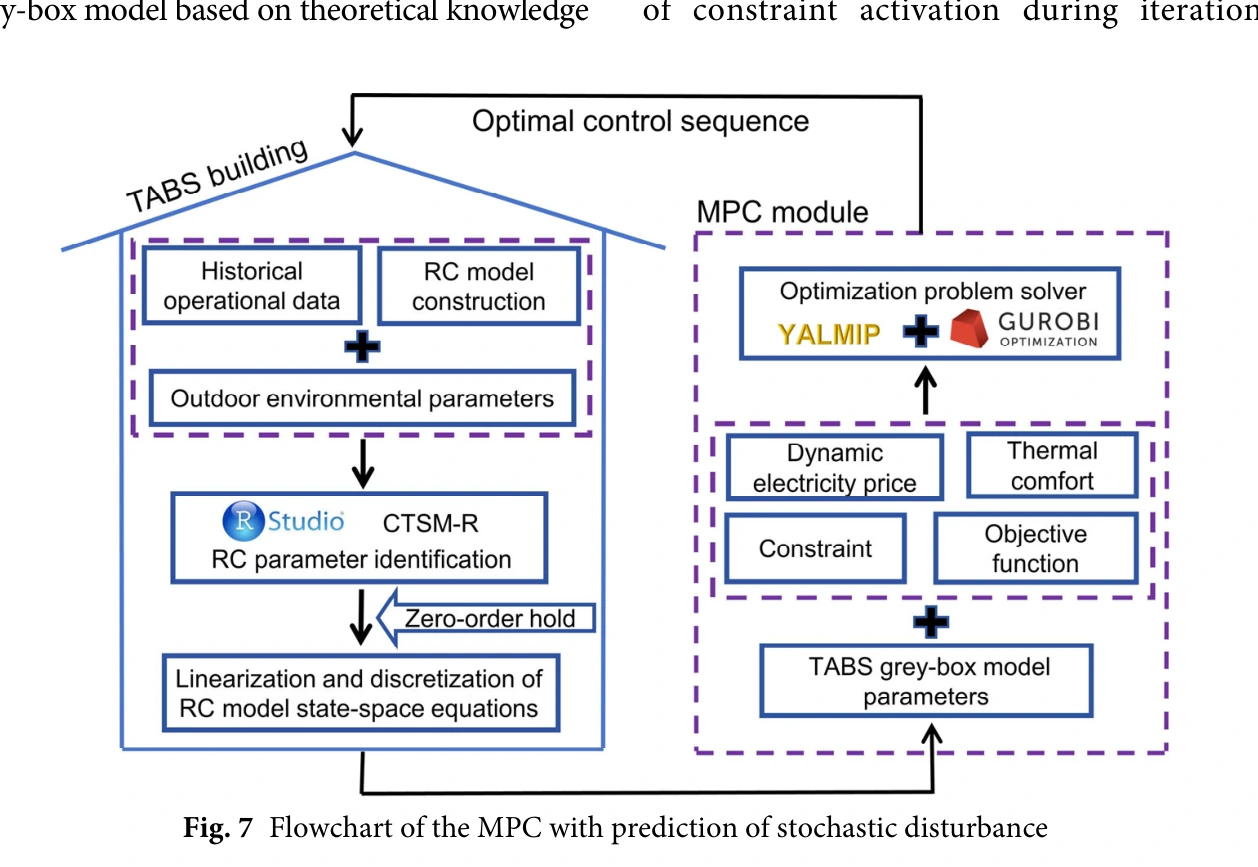
Hybrid physics-neural-network MPC with stochastic disturbance forecasting for high-inertia thermally activated building systems
The paper integrates physics-based dynamics, data-driven disturbance prediction, and predictive control.
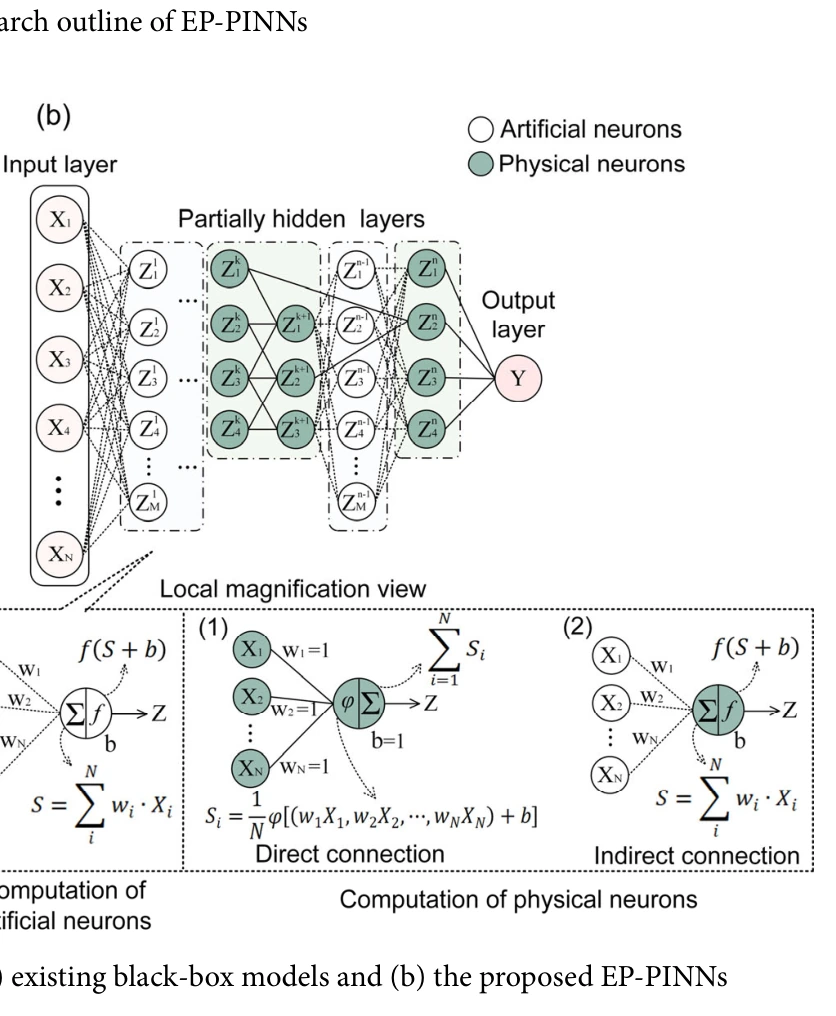
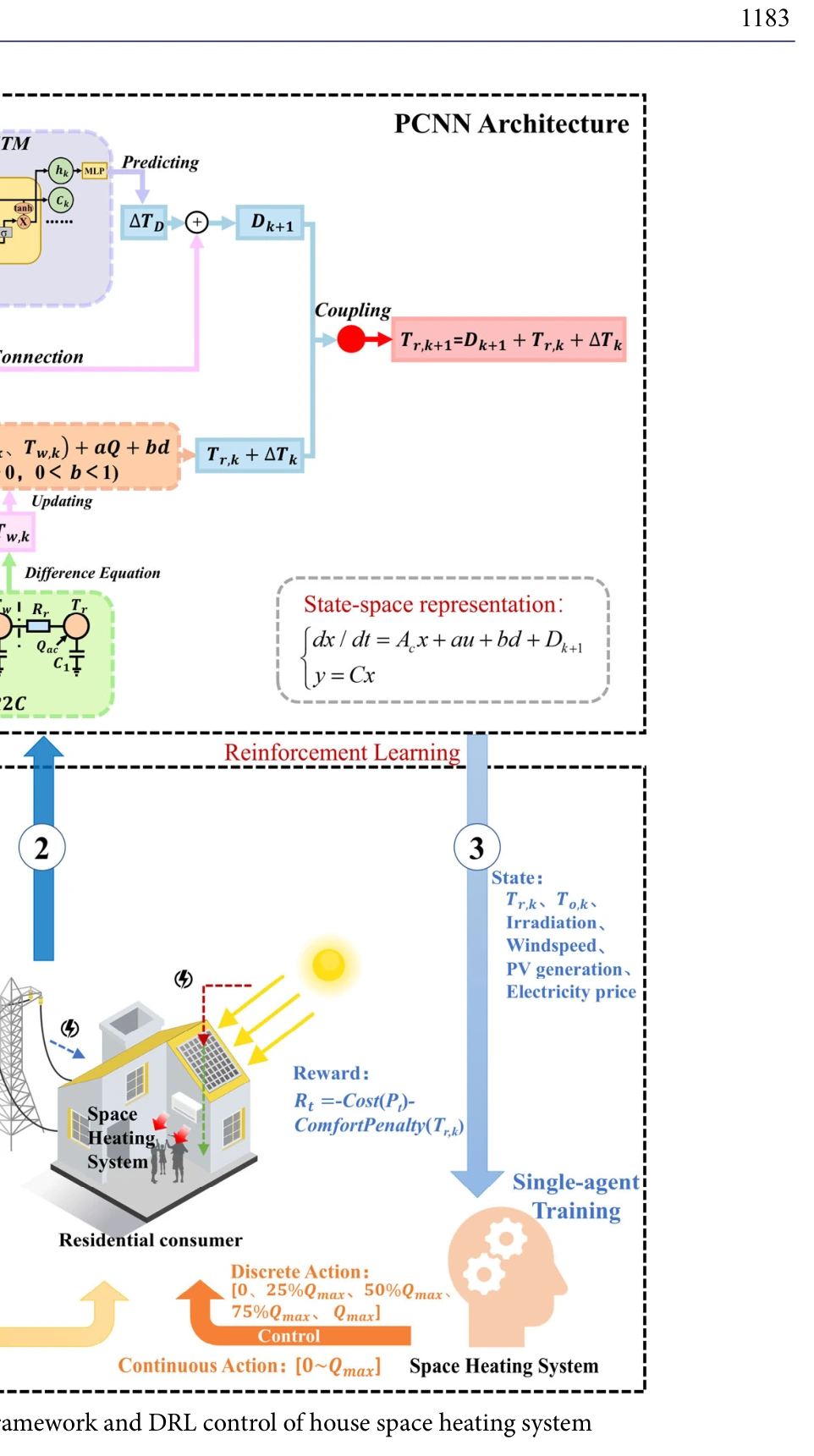
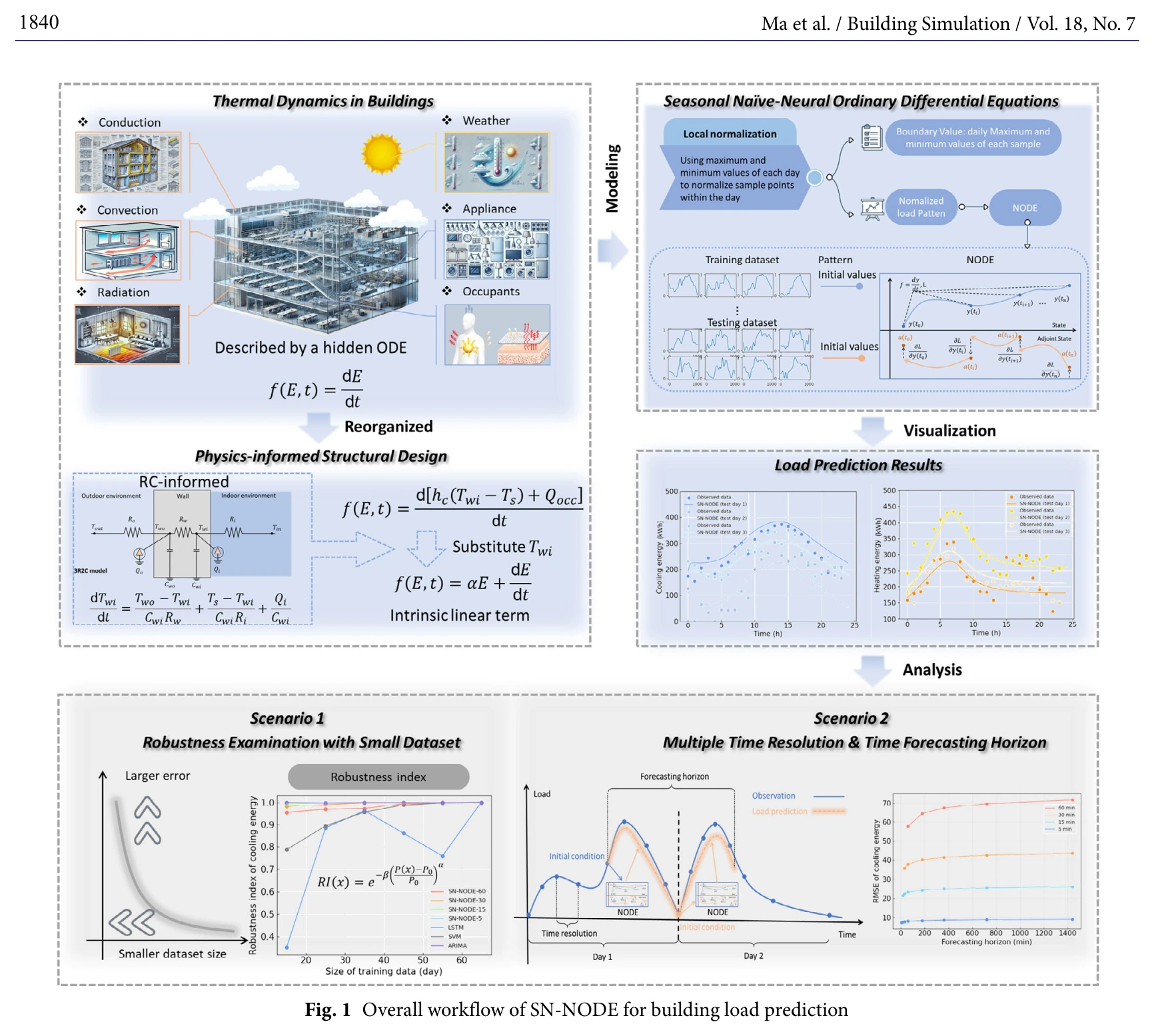
Four routes are represented: grey-box dynamics coupled with neural disturbance forecasting, physical neurons embedded in network architecture, physically consistent neural networks used in reinforcement learning, and RC-informed neural ordinary differential equations for small datasets. The common objective is to improve generalization, interpretability, robustness, or control reliability beyond purely data-driven models.
| Paper | Research problem | Method | Reported evidence |
|---|---|---|---|
| Yang et al. (2025) | High-inertia thermally activated building systems are difficult to control when key disturbances such as occupancy and solar irradiance are stochastic or unmeasured. | A hybrid MPC framework combines grey-box system modeling with neural-network disturbance forecasting and compares no-, single-, and multi-disturbance prediction strategies. | Relative to conventional MPC, disturbance-aware MPC reduces temperature violations by 20%–42%, cuts cost by 6%, and improves energy flexibility by 3.1%–8.6%. |
| Fang et al. (2025) | Chiller models trained on sparse operating data may extrapolate poorly and provide limited physical interpretability. | EP-PINNs embed physical neurons directly in the network architecture and use simplified physical-loss terms during training. | The method is tested on four chillers and is reported to maintain high accuracy while improving generalization and interpretability relative to purely data-driven models. |
| Ran et al. (2025) | Residential heating control under cold snaps requires models that are accurate, robust, interpretable, and efficient enough for control optimization. | A physically consistent neural network is compared with RC and conventional data-driven models, then embedded in a deep-reinforcement-learning controller. | The abstract reports up to 93.9% lower MAE than the RC model, mean indoor temperature of 21.9°C, 69.2% PV consumption, about 37% lower grid imports, and nearly 48% lower energy cost. |
| Ma et al. (2025) | Conventional machine-learning energy models can degrade sharply when only small training datasets are available. | The seasonal naïve neural ODE model incorporates an RC-informed structure and introduces a nonlinear robustness index. | The reported hourly and sub-hourly CVRMSE values are about 0.3 and 0.2; the model remains effective with only two weeks of training data and outperforms LSTM under comparable data scarcity. |
The paper integrates physics-based dynamics, data-driven disturbance prediction, and predictive control.
The work shifts physics-informed learning from loss-only constraints toward explicit physics-based information flow inside the network.
The study evaluates physical consistency not only for prediction but also for control, comfort, and grid interaction.
The paper combines continuous-time learning, physical structure, and explicit robustness analysis for small-data energy modeling.