Research problem
Typical meteorological year files may not represent local urban microclimates well enough for accurate building energy simulation.
The paper shows how urban morphology and wind-aware microclimate prediction can improve building-energy inputs.
Authors: Li, Qi; Luo, Xiaowei; Hu, Maomao
Journal: Building Simulation, 2025, volume 18, issue 11, pages 3133–3152
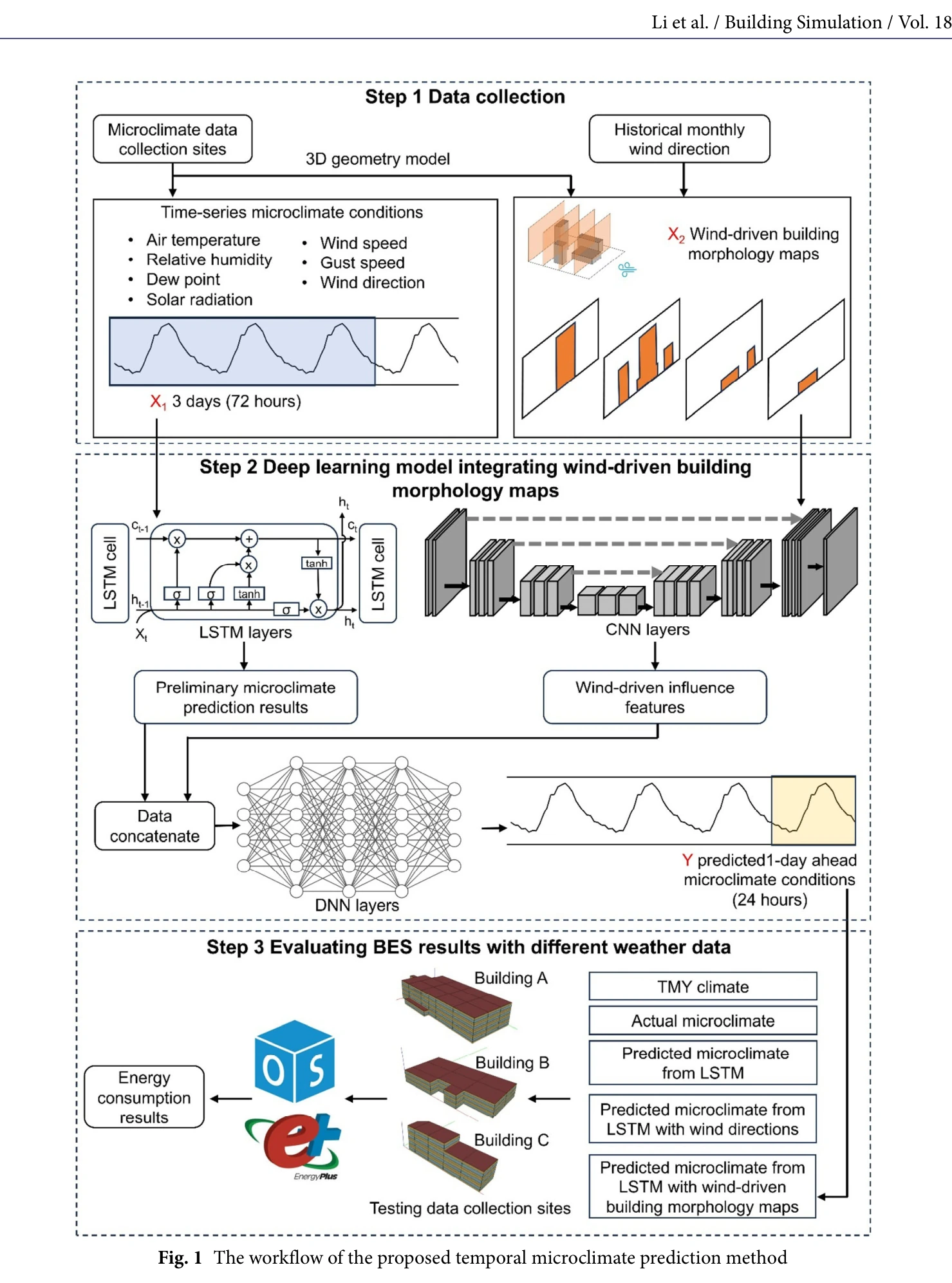
Accurate building energy simulation (BES) is essential for developing effective energy conservation strategies and implementing evidence-based policy interventions in the built environment. However, BES accuracy is often undermined by unrealistic weather data, as conventional Typical Meteorological Year (TMY) files fail to adequately capture urban microclimate variations. This study proposes a deep learning model that integrates wind-driven building morphology maps for high-resolution temporal microclimate prediction. By combining macro-scale wind dynamics with urban morphological features, encoded as frontal area maps, the model captures seasonal microclimate variations influenced by prevailing wind conditions. Validation conducted on a university campus demonstrates that the proposed model outperforms benchmark approaches in predicting air temperature and relative humidity (RH). The ground truth for validation is the real-time microclimate data collected by weather stations installed across the campus. Compared to TMY files, a standard deep learning model, and a deep learning model with wind directions, the proposed model reduces the root mean squared error (RMSE) in air temperature by 36.3%, 14.2%, and 14.0%, and RMSE in RH by 30.5%, 17.3%, and 17.3%, respectively. When integrated into BES for three test buildings, the model's weather data enabled cooling energy prediction with less than 2% error, significantly outperforming alternative methods. Overall, the proposed model allows cross-building temporal microclimate prediction without requiring long-term weather data collection at the target building.
Typical meteorological year files may not represent local urban microclimates well enough for accurate building energy simulation.
A deep-learning model integrates seasonal wind dynamics with building-morphology maps encoded through frontal-area information.
Campus validation reports lower temperature and humidity RMSE than TMY and benchmark models; when used in simulation for three buildings, cooling-energy prediction error is below 2%.
The paper shows how urban morphology and wind-aware microclimate prediction can improve building-energy inputs.
Li, Qi; Luo, Xiaowei; Hu, Maomao. Impact of seasonal wind and building morphology on microclimate and building energy consumption. Building Simulation , 2025, 18, 3133–3152. https://doi.org/10.1007/s12273-025-1365-0
Use the DOI record as the primary source for formal scholarly citation.