Research problem
Data-driven design-load models may not generalize across buildings with diverse and complex geometries.
The paper applies graph representation learning to fast, geometry-aware uncertainty quantification at design stage.
Authors: Lu, Jie; Zheng, Zeyu; Zhang, Chaobo; Zhao, Yang; Feng, Chenxin; Choudhary, Ruchi
Journal: Building Simulation, 2025, volume 18, issue 2, pages 321–337
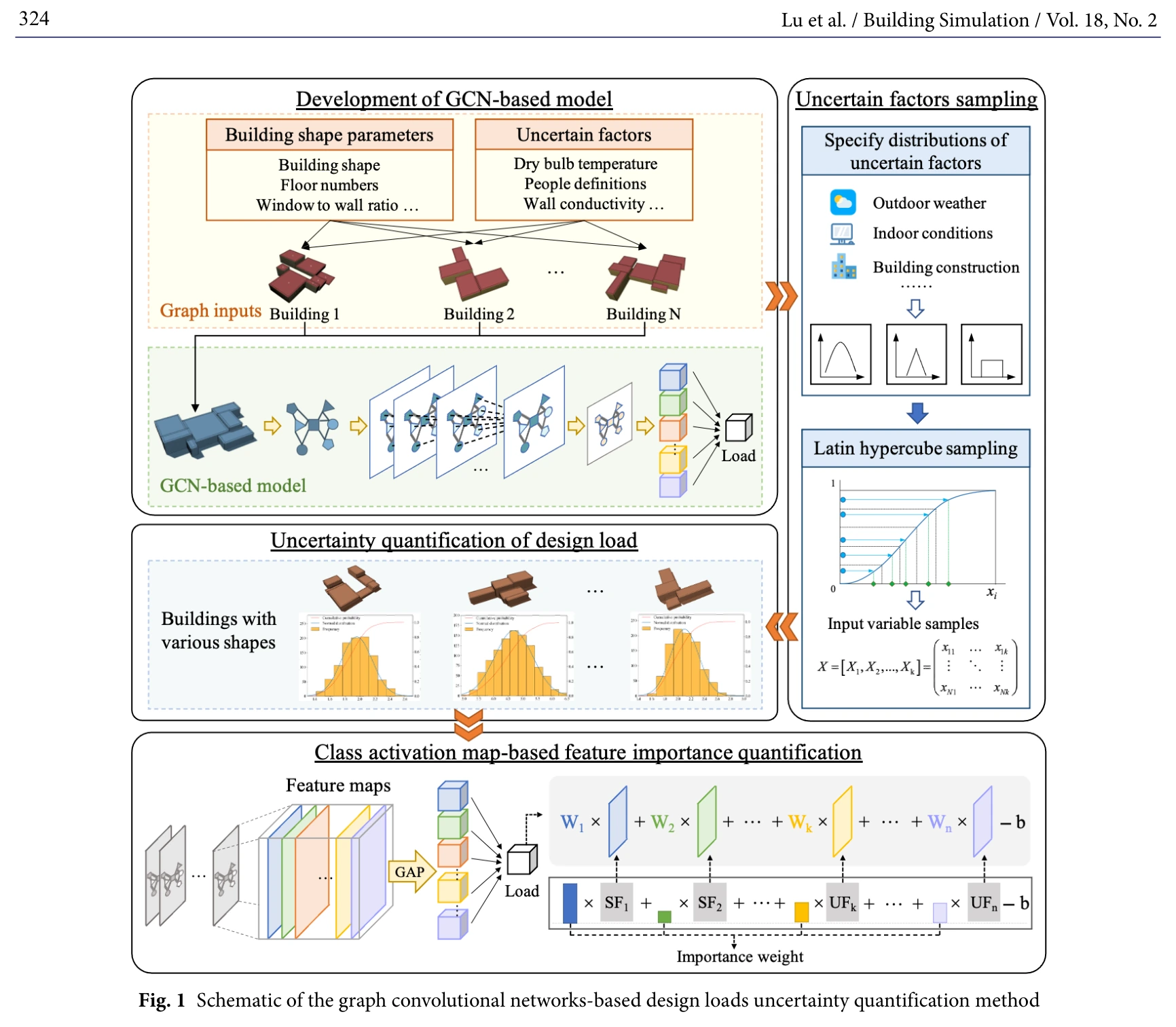
Uncertainty quantification of building design loads is essential to efficient and reliable building energy planning in the design stage. Current data-driven methods struggle to generalize across buildings with diverse shapes due to limitations in representing complex geometric structures. To tackle this issue, a graph convolutional networks (GCN)-based uncertainty quantification method is proposed. This graph-based approach is introduced to represent building shapes by dividing them into blocks and defining their spatial relationships through nodes and edges. The method effectively captures complex building characteristics, enhancing the generalization abilities. An approach leveraging GCN could estimate design loads by understanding the impact of diverse uncertain factors. Additionally, a class activation map is formulated to identify key uncertain factors, guiding the selection of important design parameters during the building design stage. The effectiveness of this method is evaluated through comparison with four widely-used data-driven techniques. Results indicate that the mean absolute percentage errors (MAPE) for statistical indicators of uncertainty quantification are under 6.0% and 4.0% for cooling loads and heating loads, respectively. The proposed method is demonstrated to quantify uncertainty in building design loads with outstanding generalization abilities. With regard to time costs, the computation time of the proposed method is reduced from 331 hours to 30 seconds for a twenty-floor building compared to a conventional physics-based method.
Data-driven design-load models may not generalize across buildings with diverse and complex geometries.
Buildings are represented as graphs of blocks, nodes, and spatial edges; a GCN predicts uncertainty statistics and a class-activation map identifies influential uncertain factors.
Reported MAPE is below 6% for cooling-load statistics and below 4% for heating-load statistics, while computation for a 20-floor building drops from 331 hours to 30 seconds relative to the physics-based workflow.
The paper applies graph representation learning to fast, geometry-aware uncertainty quantification at design stage.
Lu, Jie; Zheng, Zeyu; Zhang, Chaobo; Zhao, Yang; Feng, Chenxin; Choudhary, Ruchi. Graph convolutional networks-based method for uncertainty quantification of building design loads. Building Simulation , 2025, 18, 321–337. https://doi.org/10.1007/s12273-024-1212-8
Use the DOI record as the primary source for formal scholarly citation.