Research problem
Conventional machine-learning energy models can degrade sharply when only small training datasets are available.
The paper combines continuous-time learning, physical structure, and explicit robustness analysis for small-data energy modeling.
Authors: Ma, Zhihao; Jiang, Gang; Chen, Jianli
Journal: Building Simulation, 2025, volume 18, issue 7, pages 1837–1856
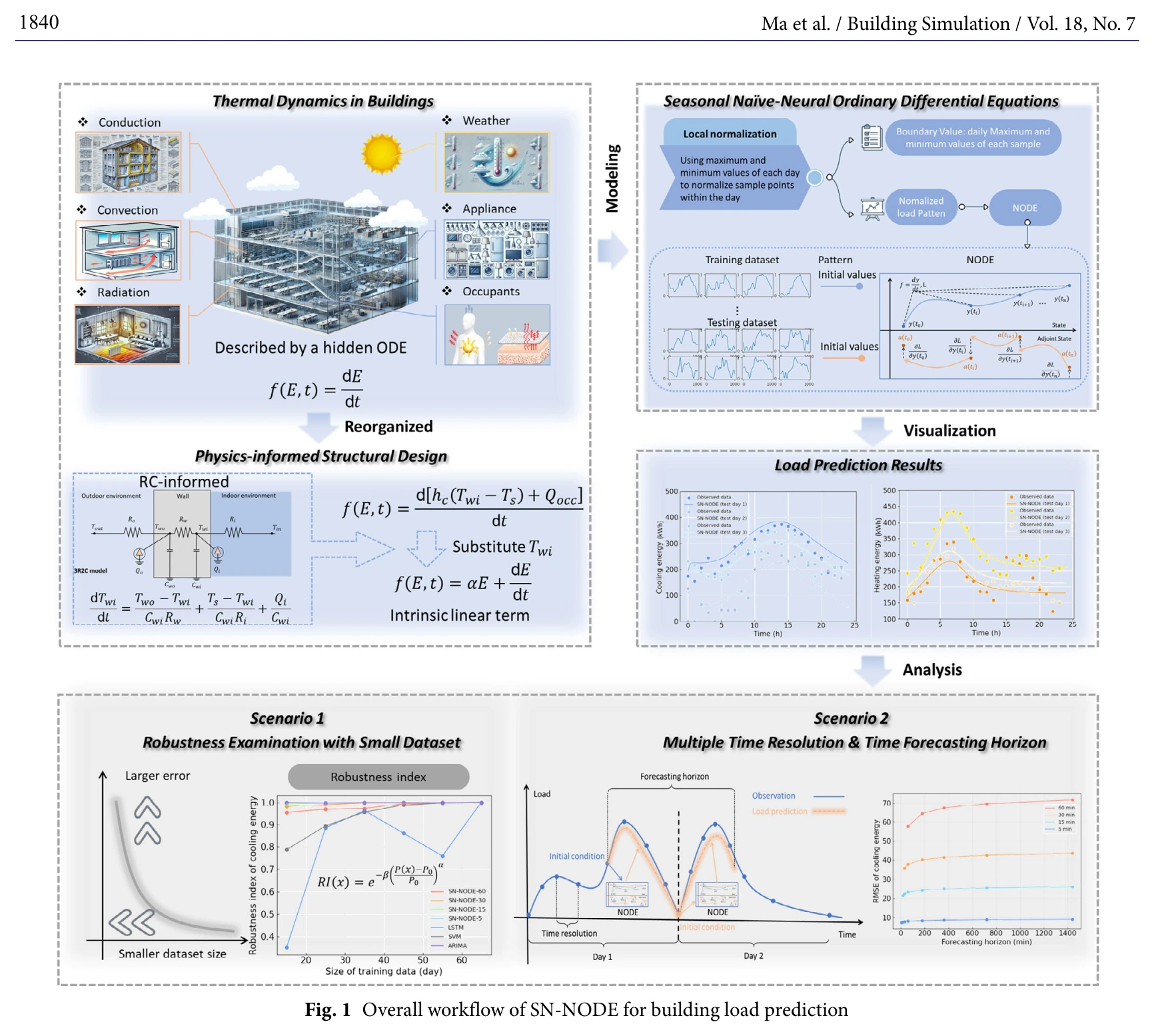
The substantial progress in machine learning (ML) techniques and the growing availability of building data have created significant opportunities for rapid and precise building energy modeling. However, despite the notable capabilities of ML algorithms, their performance could severely degrade when available training dataset is limited, undermining trustworthiness and effectiveness of model application in practice. To address this challenge, this study develops the seasonal naïve-neural-ordinary differential equations (SN-NODE) model to predict the cooling and heating loads of buildings, especially in scenarios with severe data scarcity. By incorporating a physics-informed structure into SN-NODE, the model aligns predictions with the underlying physical principle governed by resistance-capacitance (RC) models, enhancing both accuracy and reliability. The resulting predictions for hourly and sub-hourly cooling and heating loads achieved a coefficient of variation of root mean square error (CVRMSE) of approximately 0.3 and 0.2, respectively, demonstrating its strong potential for accurate building load prediction. The physics-informed structure further improved prediction accuracy over the original SN-NODE when trained with hourly dataset, ensuring physically consistent and interpretable results. Moreover, a robustness index (RI) function was proposed to evaluate the model robustness in a nonlinear manner, showcasing the superior performance of the SN-NODE model with limited training data compared to conventional data-driven models including long-short term memory (LSTM) and support vector machine (SVM). Notably, the SN-NODE model maintained high prediction accuracy even with only two weeks of training data, whereas the performance of LSTM decreased dramatically (CVRMSE increases from approximately 0.3 to 0.5) under similar conditions. Finally, the SN-NODE model exhibited robust performance across different time resolutions and forecasting horizons, achieving CVRMSE ranging from approximately 0.15 to 0.3 in building energy use prediction.
Conventional machine-learning energy models can degrade sharply when only small training datasets are available.
The seasonal naïve neural ODE model incorporates an RC-informed structure and introduces a nonlinear robustness index.
The reported hourly and sub-hourly CVRMSE values are about 0.3 and 0.2; the model remains effective with only two weeks of training data and outperforms LSTM under comparable data scarcity.
The paper combines continuous-time learning, physical structure, and explicit robustness analysis for small-data energy modeling.
Ma, Zhihao; Jiang, Gang; Chen, Jianli. Neural ordinary differential equations-based approach for enhanced building energy modeling on small datasets. Building Simulation , 2025, 18, 1837–1856. https://doi.org/10.1007/s12273-025-1269-z
Use the DOI record as the primary source for formal scholarly citation.