Research problem
Residential heating control under cold snaps requires models that are accurate, robust, interpretable, and efficient enough for control optimization.
The study evaluates physical consistency not only for prediction but also for control, comfort, and grid interaction.
Authors: Ran, Yi; Wang, Zixuan; Li, Yanxue; Xiao, Fu
Journal: Building Simulation, 2025, volume 18, issue 5, pages 1179–1204
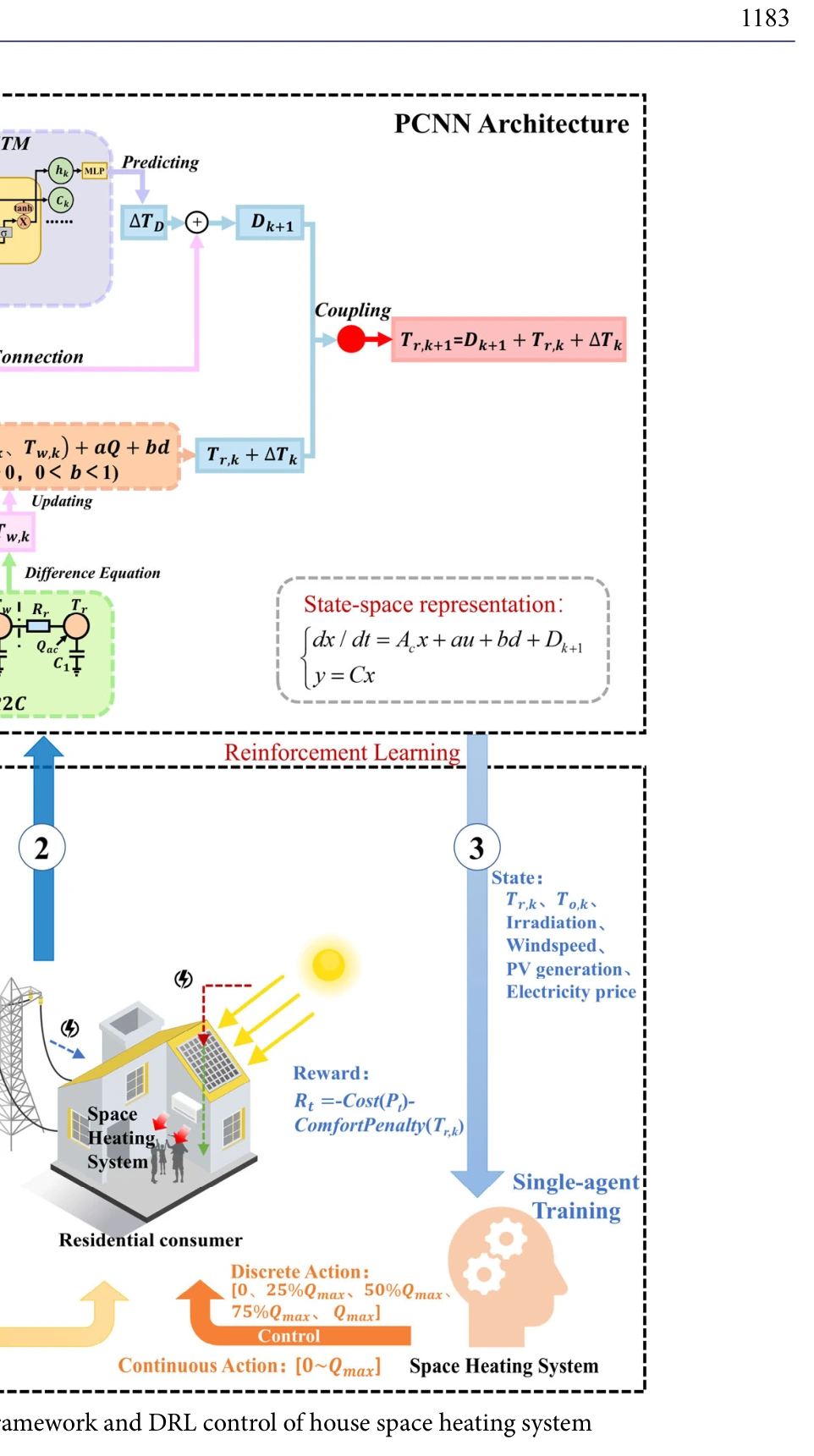
Reliable and efficient modeling of residential space heating systems is crucial for optimizing building energy usage, especially during extreme cold snap events. Traditional white-box models require significant expertise and time-intensive parameterization, whereas simplified grey-box resistance-capacitance (RC) models often suffer from limited accuracy and frequent recalibrations. Although purely data-driven methods show promise in predictive performance, they lack scalability and interpretability. To address these limitations, the study proposes a physically consistent neural network (PCNN) that integrates fundamental heat transfer principles with data-driven learning. This study compares the performance of grey-box RC models, conventional data-driven models, and the proposed PCNN within a deep reinforcement learning (DRL) framework for space heating control. The evaluation focuses on each model's predictive accuracy under severe cold snap conditions, as well as their impact on indoor comfort, grid imports, and photovoltaic (PV) utilization. Results show that the PCNN achieves up to a 93.9% reduction in mean absolute error (MAE) prediction errors compared to the RC model and exhibits greater robustness to abrupt temperature drops. When incorporated into DRL controllers, the PCNN enhances indoor temperature stability, increases on-site PV consumption, and reduces energy dependence. Additionally, the PCNN can be effectively trained with smaller datasets without sacrificing accuracy. Although the PCNN model demonstrates higher computational overhead during DRL optimization, its moderate complexity is offset by its enhanced reliability. Notably, the PCNN outperforms all other models in continuous control scenarios, maintaining a mean indoor temperature of 21.9 degrees C with a minimal deviation of -0.1 degrees C, reaching a 69.2% PV consumption rate, lowering total grid imports by approximately 37%, and reducing overall energy costs by nearly 48% compared to measured results.
Residential heating control under cold snaps requires models that are accurate, robust, interpretable, and efficient enough for control optimization.
A physically consistent neural network is compared with RC and conventional data-driven models, then embedded in a deep-reinforcement-learning controller.
The abstract reports up to 93.9% lower MAE than the RC model, mean indoor temperature of 21.9°C, 69.2% PV consumption, about 37% lower grid imports, and nearly 48% lower energy cost.
The study evaluates physical consistency not only for prediction but also for control, comfort, and grid interaction.
Ran, Yi; Wang, Zixuan; Li, Yanxue; Xiao, Fu. Performance evaluation of physical consistency approach for optimizing residential space heating system in cold snap conditions. Building Simulation , 2025, 18, 1179–1204. https://doi.org/10.1007/s12273-025-1253-7
Use the DOI record as the primary source for formal scholarly citation.