Research problem
Early-stage building design requires simultaneous prediction and optimization of energy use, daylight availability, and thermal comfort.
This paper connects predictive accuracy, model interpretation, and multi-objective design optimization in one workflow.
Authors: Shen, Yeqin; Hu, Yubing; Cheng, Kai; Yan, Hainan; Cai, Kaixiang; Hua, Jianye; Fei, Xuemin; Wang, Qinyu
Journal: Building Simulation, 2024, volume 17, issue 5, pages 819–838
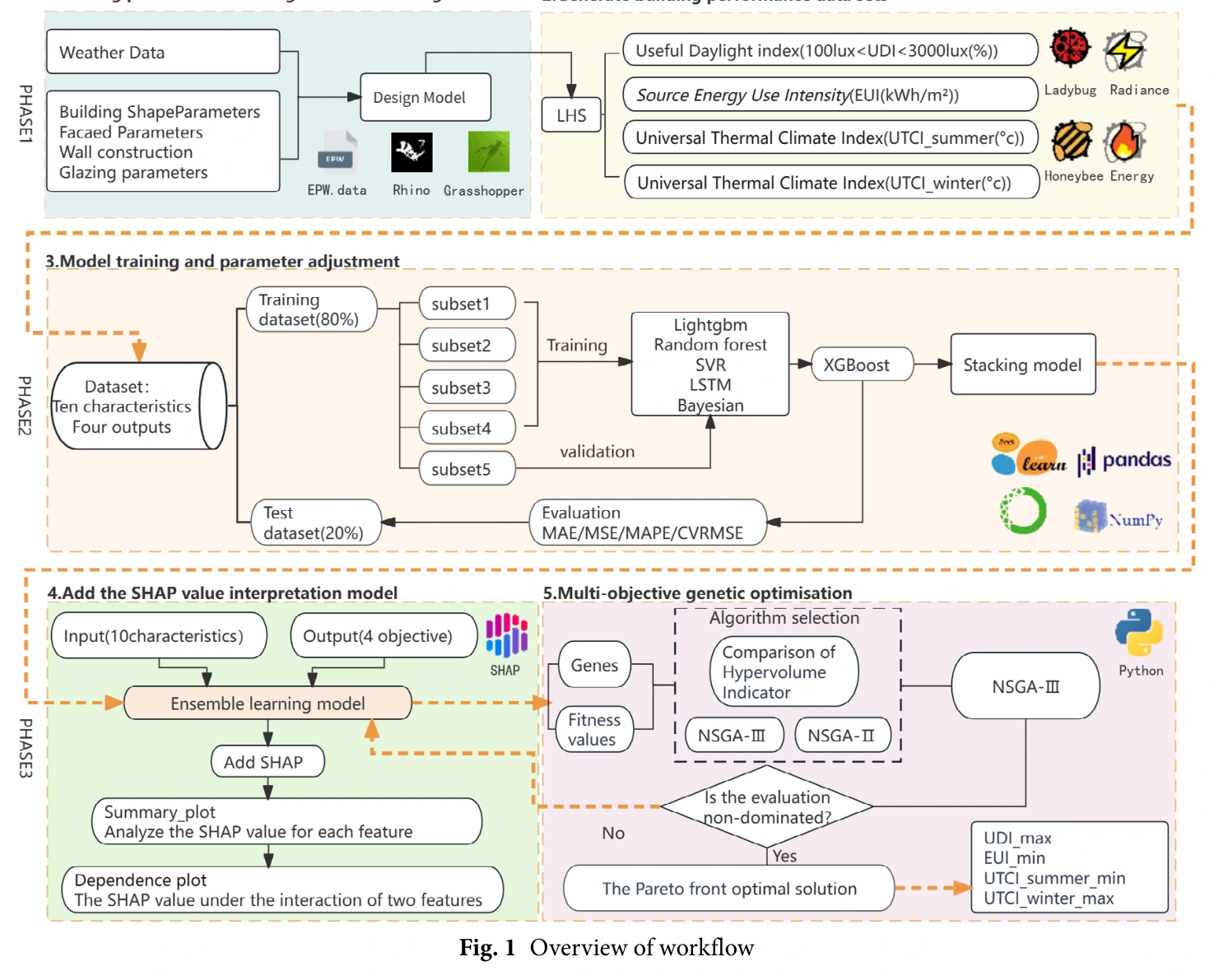
This study develops an approach consisting of a stacking model integrated with a multi-objective optimisation algorithm aimed at predicting and optimising the ecological performance of buildings. The integrated model consists of five base models and a meta-model, which significantly improves the prediction performance. Specifically, the R2 value was improved by 9.19% and the error metrics MAE, MSE, MAPE, and CVRMSE were reduced by 69.47%, 79.88%, 67.32%, and 57.02%, respectively, compared to the single prediction model. According to the research on interpretable machine learning, adding the SHAP value gives us a deeper understanding of the impact of each architectural design parameter on the performance. In the multi-objective optimisation part, we used the NSGA-III algorithm to successfully improve the energy efficiency, daylight utilisation and thermal comfort of the building. Specifically, the optimal design solution reduces the energy use intensity by 31.6 kWh/m2, improves the useful daylight index by 39%, and modulated the thermal comfort index, resulting in a decrement of 0.69 degrees C for the summer season and an enhancement of 0.64 degrees C for the winter season, respectively. Overall, this study provides building designers and decision makers with a tool to make better design decisions at an early stage to achieve a better combination of energy efficiency, daylight utilisation and thermal comfort optimisation in an integrated manner, providing an important support for achieving sustainable building design.
Early-stage building design requires simultaneous prediction and optimization of energy use, daylight availability, and thermal comfort.
A stacking ensemble with five base learners and a meta-model is combined with SHAP interpretation and NSGA-III multi-objective optimization.
The reported results include a 9.19% improvement in R², substantial reductions in four error metrics, a 31.6 kWh/m² reduction in energy use intensity, a 39% increase in useful daylight index, and improved seasonal thermal-comfort indicators.
This paper connects predictive accuracy, model interpretation, and multi-objective design optimization in one workflow.
Shen, Yeqin; Hu, Yubing; Cheng, Kai; Yan, Hainan; Cai, Kaixiang; Hua, Jianye; Fei, Xuemin; Wang, Qinyu. Utilizing interpretable stacking ensemble learning and NSGA-III for the prediction and optimisation of building photo-thermal environment and energy consumption. Building Simulation , 2024, 17, 819–838. https://doi.org/10.1007/s12273-024-1108-7
Use the DOI record as the primary source for formal scholarly citation.