Research problem
A single global forecasting model may overlook heterogeneous local patterns in complex building-energy time series.
The work applies a collaborative mixture-of-experts architecture to heterogeneous building-energy forecasting.
Authors: Tan, Wei; Wang, Yunzhe; Fu, Qiming; Lu, You; Chen, Jianping
Journal: Building Simulation, 2025, volume 18, issue 10, pages 2741–2756
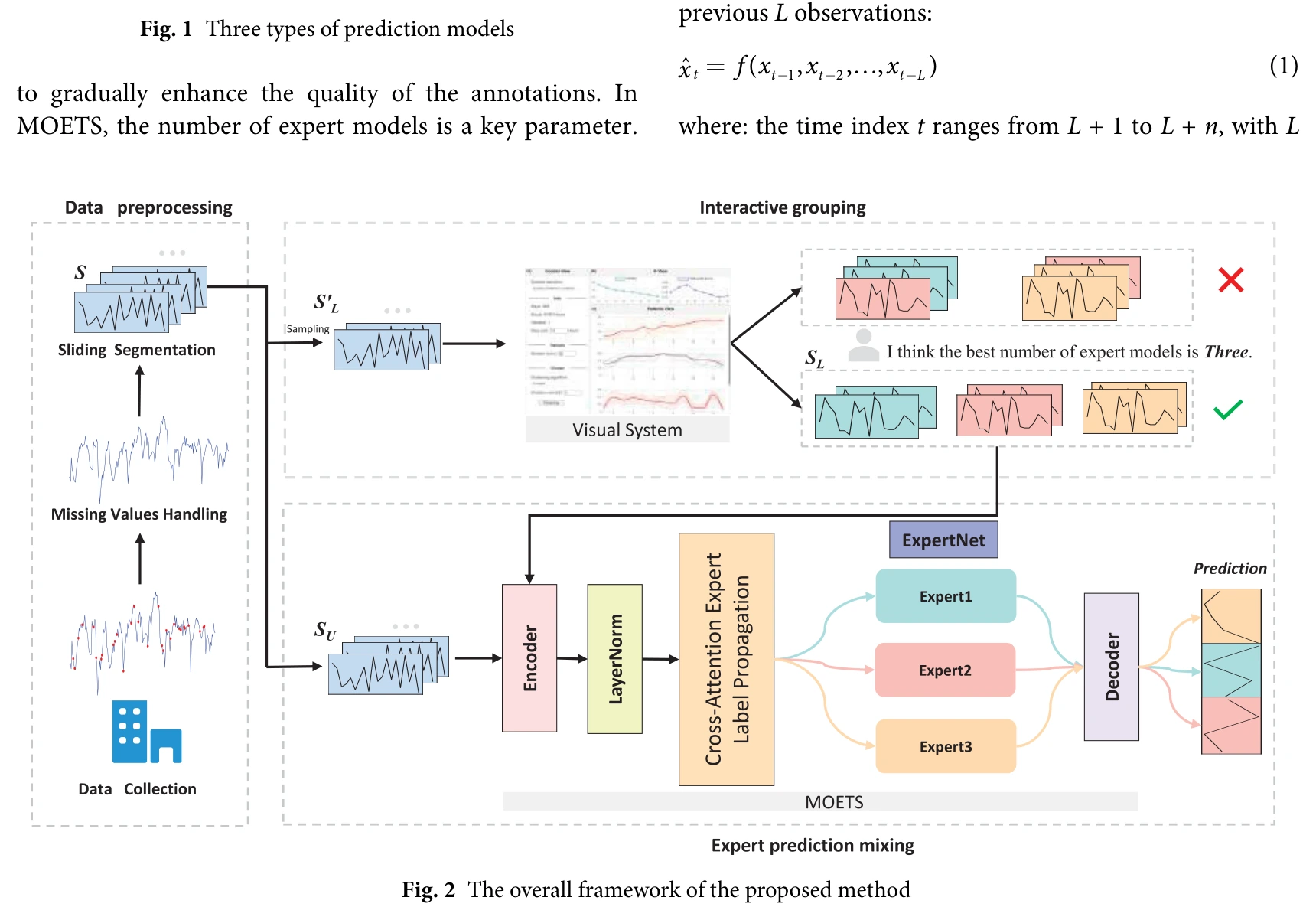
Accurate prediction of energy consumption is crucial in the field of building energy efficiency, where artificial intelligence plays a significant role. However, existing methods still face considerable challenges in predicting complex energy consumption. Traditional models primarily aim to optimize overall objectives but often overlook local characteristics in the data, which places higher demands on the learning and generalization capabilities of predictive models. This paper introduces the Mixture of Experts for Time Series Prediction (MOETS) framework, which is a multi-expert collaborative forecasting framework designed to address the limitations of traditional models in forecasting diverse building energy consumption patterns. MOETS employs a cross-attention expert label propagation mechanism to dynamically select and activate the most suitable expert model from ExpertNet for prediction based on series characteristics, thereby achieving high prediction accuracy while maintaining exceptional computational efficiency. To optimize the number of expert models in ExpertNet, which directly impacts prediction accuracy, we developed an auxiliary visual system. This tool enables users to determine the optimal number of expert models, incorporate domain knowledge, and annotate subsets of data with expert series labels, thereby enhancing the accuracy of MOETS and reducing the time required for manual tuning. Additionally, users annotate subsets of data with expert series labels to guide the allocation of expert models within MOETS. We tested MOETS on seven datasets. The results show that compared to the baseline model, MOETS achieved a maximum reduction of 8.1% in RMSE and a maximum reduction of 6.2% in MAE. Additionally, the prediction speed was improved by 29.8%.
A single global forecasting model may overlook heterogeneous local patterns in complex building-energy time series.
MOETS uses cross-attention expert-label propagation to select specialized experts according to series characteristics, supported by a visual tool for expert-number selection and domain annotation.
Across seven datasets, the reported maximum improvements are 8.1% lower RMSE, 6.2% lower MAE, and 29.8% faster prediction.
The work applies a collaborative mixture-of-experts architecture to heterogeneous building-energy forecasting.
Tan, Wei; Wang, Yunzhe; Fu, Qiming; Lu, You; Chen, Jianping. A collaborative mixture of experts framework for building energy consumption prediction. Building Simulation , 2025, 18, 2741–2756. https://doi.org/10.1007/s12273-025-1334-7
Use the DOI record as the primary source for formal scholarly citation.