Research problem
Occupancy and air-conditioning switching behavior jointly shape office energy use, but are often modeled separately.
The study connects behavior prediction, multi-sensor fusion, and occupant-centered HVAC control.
Authors: Yu, Yingying; Liu, Lamei; Wang, Xing; Li, Yang; Gao, Jiajia; Li, Guannan; Li, Tao
Journal: Building Simulation, 2025, volume 18, issue 12, pages 3275–3294
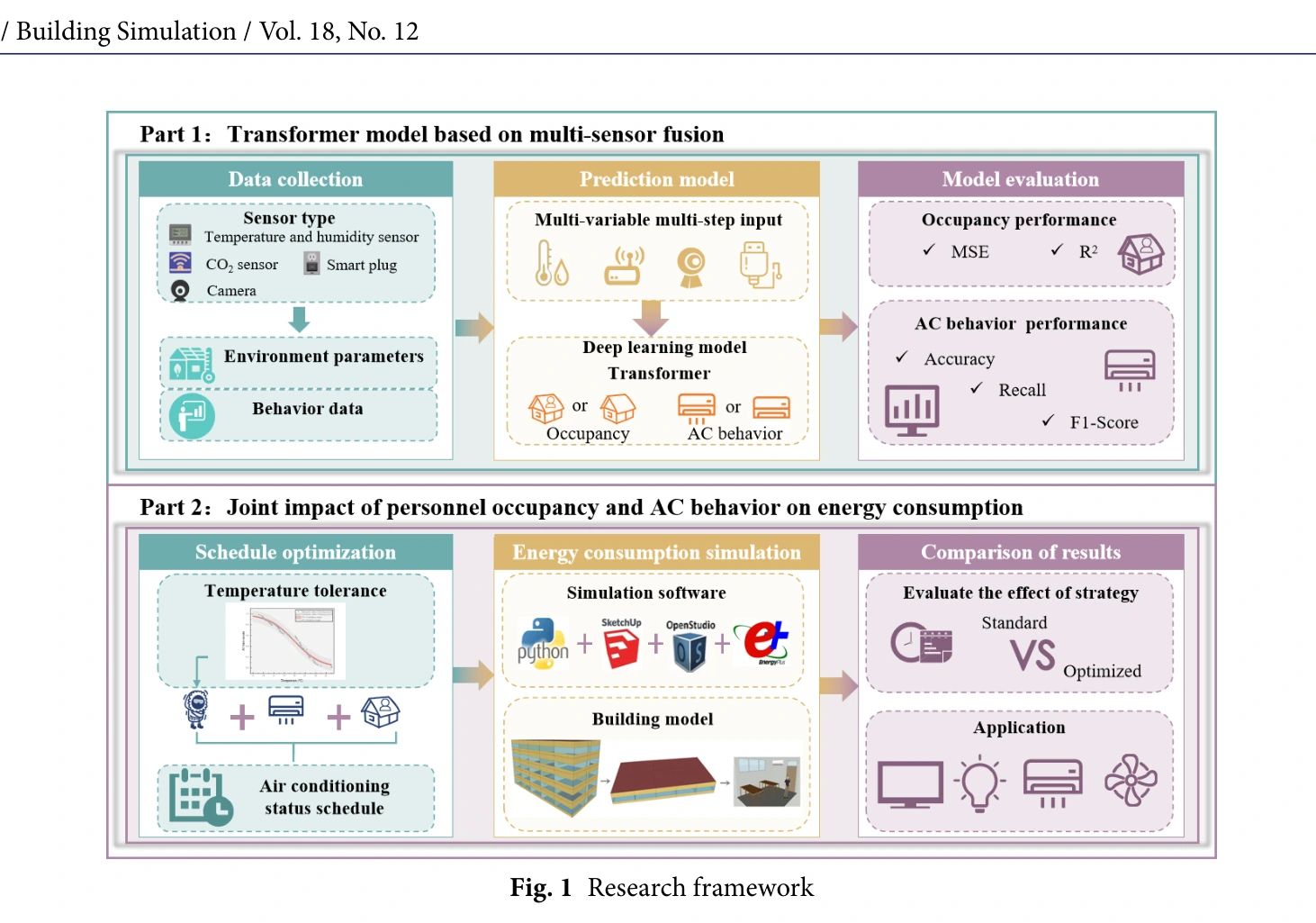
Occupancy and air-conditioning on/off behavior have a significant impact on the operational energy consumption of a building, and it is important to study their joint role in implementing occupant centered control strategies and reducing building energy consumption. We propose a control strategy based on the synergistic analysis of occupancy and air-conditioning on/off behavior, incorporating tolerance temperature parameters to achieve fine-grained energy-saving regulation of air-conditioning in campus offices. Transformer is selected to handle the complex temporal patterns inherent in occupancy and air conditioning on/off behavioral data due to its expertise in capturing long-range dependencies and multi-feature interactions in temporal data. A Transformer-based multi-feature multi-step input prediction model is constructed by deploying a variety of sensors to collect environmental and behavioral data during a month-long experimental test in two offices within a university in Wuhan. The model is able to predict personnel occupancy (R2 = 0.917) and air-conditioning on/off behavior (Accuracy = 0.988) with relatively high accuracy. The energy simulation results show that the strategy can save up to 62% energy compared to the conventional system operation mode. A comparison of the results of the two office reveals that rooms with greater randomness of occupancy have a greater potential for energy savings. This study can provide an innovative and practical control strategy for reducing air-conditioning energy consumption in campus offices, which can help to achieve efficient energy utilization.
Occupancy and air-conditioning switching behavior jointly shape office energy use, but are often modeled separately.
A Transformer-based multi-feature, multi-step model uses environmental and behavioral sensor data to predict occupancy and AC on/off behavior, followed by control-oriented energy simulation.
The reported model reaches R² = 0.917 for occupancy and 0.988 accuracy for AC behavior; the proposed strategy saves up to 62% relative to conventional operation.
The study connects behavior prediction, multi-sensor fusion, and occupant-centered HVAC control.
Yu, Yingying; Liu, Lamei; Wang, Xing; Li, Yang; Gao, Jiajia; Li, Guannan; Li, Tao. Prediction of campus office occupancy and AC behavior based on Transformer and the collective impact on energy consumption. Building Simulation , 2025, 18, 3275–3294. https://doi.org/10.1007/s12273-025-1356-1
Use the DOI record as the primary source for formal scholarly citation.