Prediction of campus office occupancy and AC behavior based on Transformer and the collective impact on energy consumption
The study connects behavior prediction, multi-sensor fusion, and occupant-centered HVAC control.
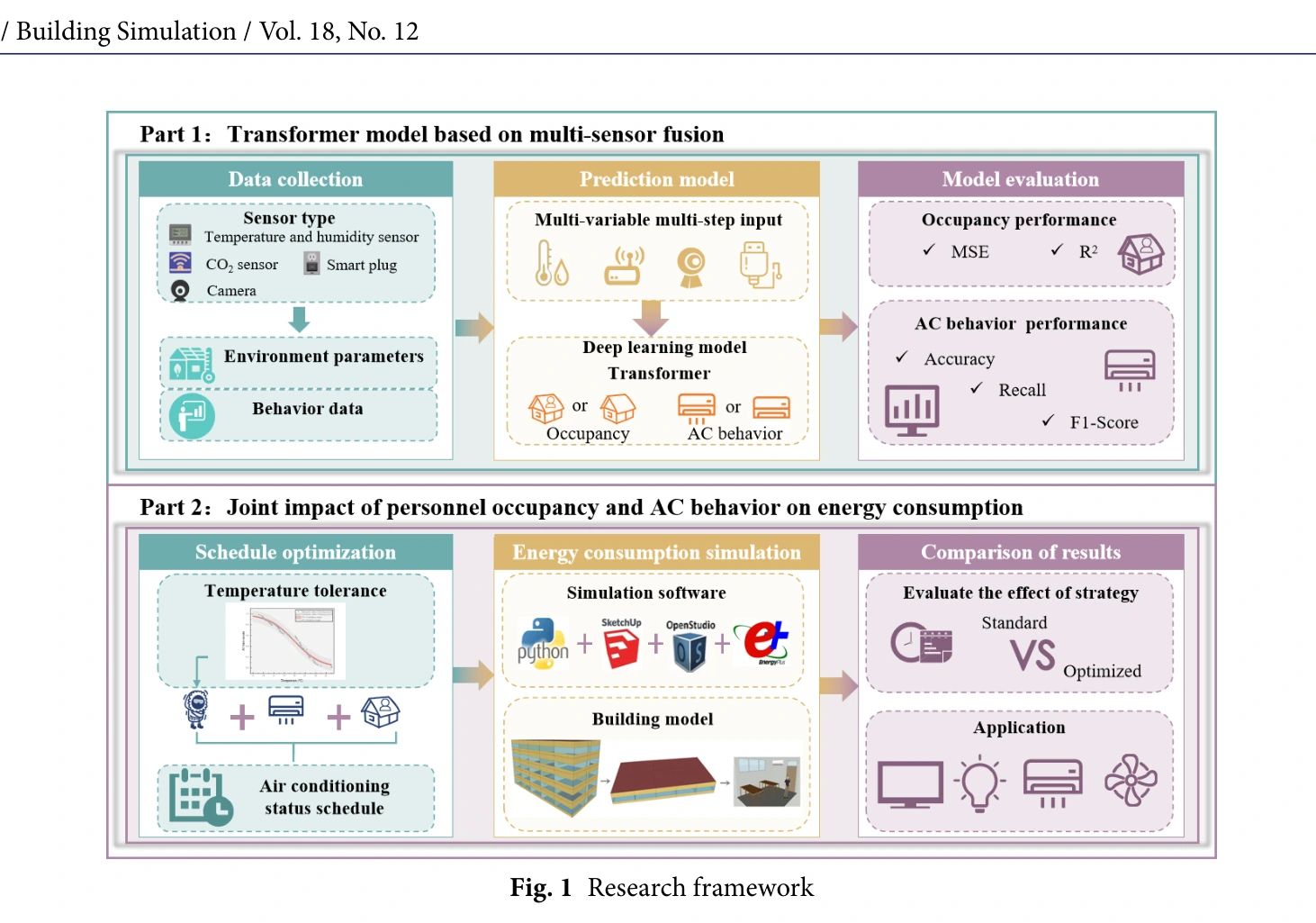
These papers integrate prediction with operational control. Yu et al. jointly forecast occupancy and AC behavior for occupant-centered office control, while Yang et al. forecast stochastic disturbances inside a hybrid MPC framework for high-inertia systems. Both demonstrate that predictive value is realized when forecasts are embedded in control decisions.
| Paper | Research problem | Method | Reported evidence |
|---|---|---|---|
| Yu et al. (2025) | Occupancy and air-conditioning switching behavior jointly shape office energy use, but are often modeled separately. | A Transformer-based multi-feature, multi-step model uses environmental and behavioral sensor data to predict occupancy and AC on/off behavior, followed by control-oriented energy simulation. | The reported model reaches R² = 0.917 for occupancy and 0.988 accuracy for AC behavior; the proposed strategy saves up to 62% relative to conventional operation. |
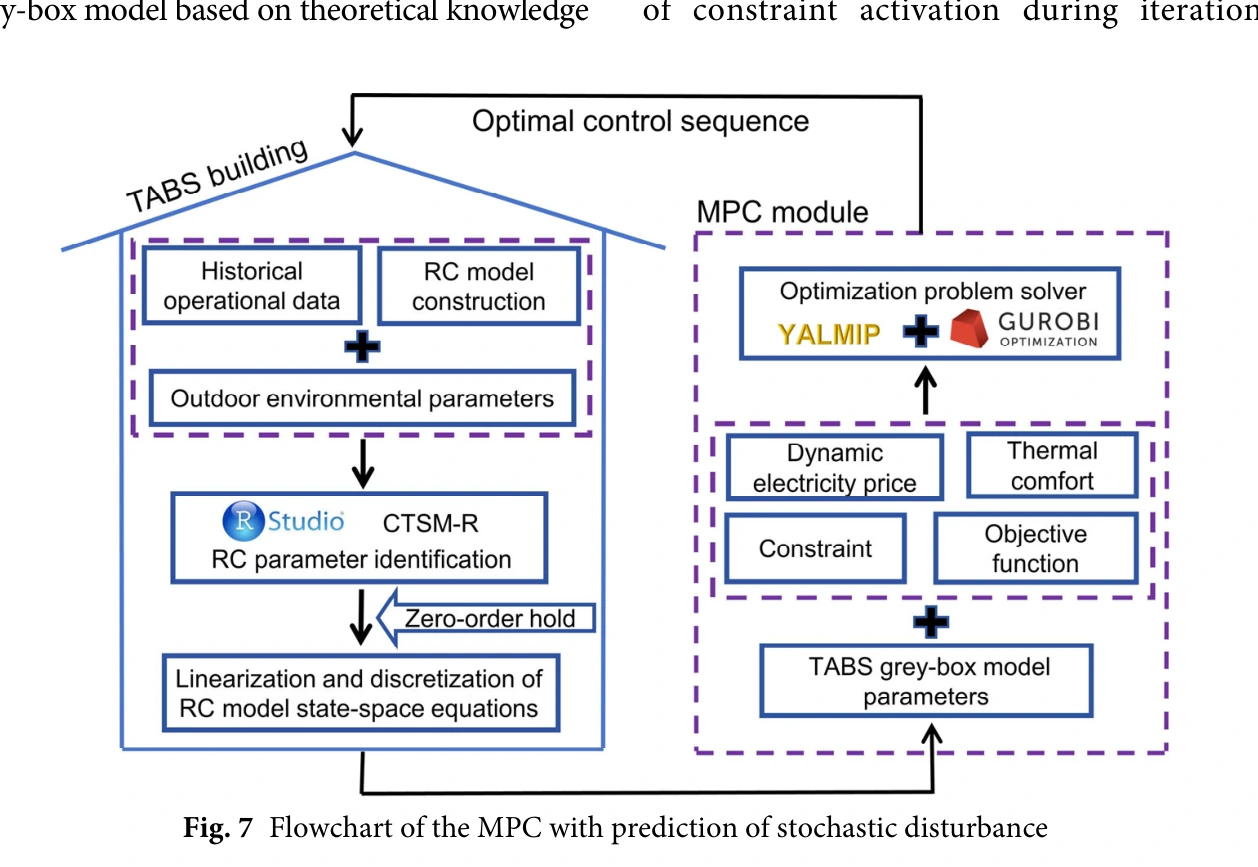
| Yang et al. (2025) | High-inertia thermally activated building systems are difficult to control when key disturbances such as occupancy and solar irradiance are stochastic or unmeasured. | A hybrid MPC framework combines grey-box system modeling with neural-network disturbance forecasting and compares no-, single-, and multi-disturbance prediction strategies. | Relative to conventional MPC, disturbance-aware MPC reduces temperature violations by 20%–42%, cuts cost by 6%, and improves energy flexibility by 3.1%–8.6%. |
The study connects behavior prediction, multi-sensor fusion, and occupant-centered HVAC control.
The paper integrates physics-based dynamics, data-driven disturbance prediction, and predictive control.