Research problem
Residential layout generators often satisfy spatial constraints without explicitly optimizing operational energy performance.
The study connects generative AI, energy prediction, and evolutionary optimization for energy-aware design.
Authors: Zeng, Pengyu; Yin, Jun; Huang, Yujian; Zhong, Jing; Lu, Shuai
Journal: Building Simulation, 2025, volume 18, issue 10, pages 2777–2805
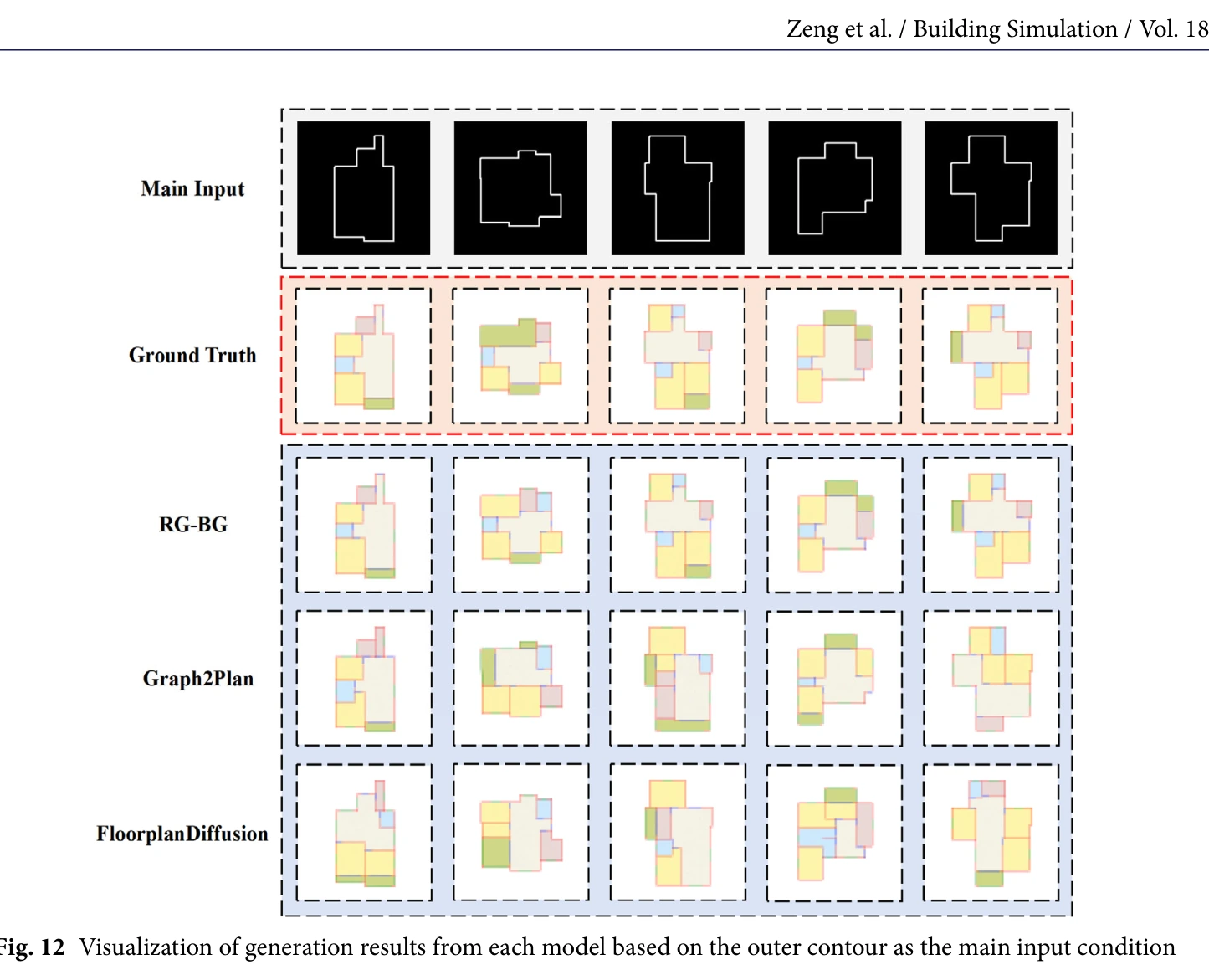
Residential energy use accounts for a substantial portion of global consumption, making its reduction critical for sustainable architectural design. However, existing generative models for residential layouts often overlook energy performance, resulting in inefficient designs and costly revisions. To address this, we propose an AI-based framework that integrates generative model, energy prediction, and evolutionary optimization. Our framework comprises three components: (1) Energy prediction: a deep learning model trained on energy simulations of 71,125 floor plans from the RPLAN dataset predicts monthly energy consumption across five categories with over 99% accuracy. (2) Generative model: a diffusion-based layout generator uses room blocks and residential contours to create diverse, high-quality floor plans under spatial constraints. (3) Optimization: a genetic algorithm iteratively refines floor plans by selecting low-energy solutions and regenerating new options, guided by the predictive model. Experiments show that our method reduces energy consumption by 17.5% compared to the best baseline model under identical conditions, demonstrating its effectiveness in reducing residential energy use. Our key contributions include the use of room blocks as chromosomes for layout evolution, and the integration of AI-based prediction and generation for energy-aware residential design.
Residential layout generators often satisfy spatial constraints without explicitly optimizing operational energy performance.
The framework combines a deep-learning energy predictor trained on 71,125 RPLAN layouts, a diffusion-based floor-plan generator, and genetic-algorithm refinement.
The predictor exceeds 99% accuracy for five monthly energy categories, and the optimized layouts reduce energy use by 17.5% relative to the best baseline under matched conditions.
The study connects generative AI, energy prediction, and evolutionary optimization for energy-aware design.
Zeng, Pengyu; Yin, Jun; Huang, Yujian; Zhong, Jing; Lu, Shuai. AI-based generation and optimization of energy-efficient residential layouts controlled by contour and room number. Building Simulation , 2025, 18, 2777–2805. https://doi.org/10.1007/s12273-025-1337-4
Use the DOI record as the primary source for formal scholarly citation.