Research problem
Utilities often possess only whole-building energy data, making it difficult to isolate HVAC demand and estimate demand-response flexibility.
The paper links unsupervised load disaggregation directly to operational flexibility assessment.
Authors: Zhang, Ying; Li, Ji; Gang, Wenjie; Dong, Shukun; Hao, Xiuxia; Tu, Zhengkai
Journal: Building Simulation, 2025, volume 18, issue 12, pages 3317–3335
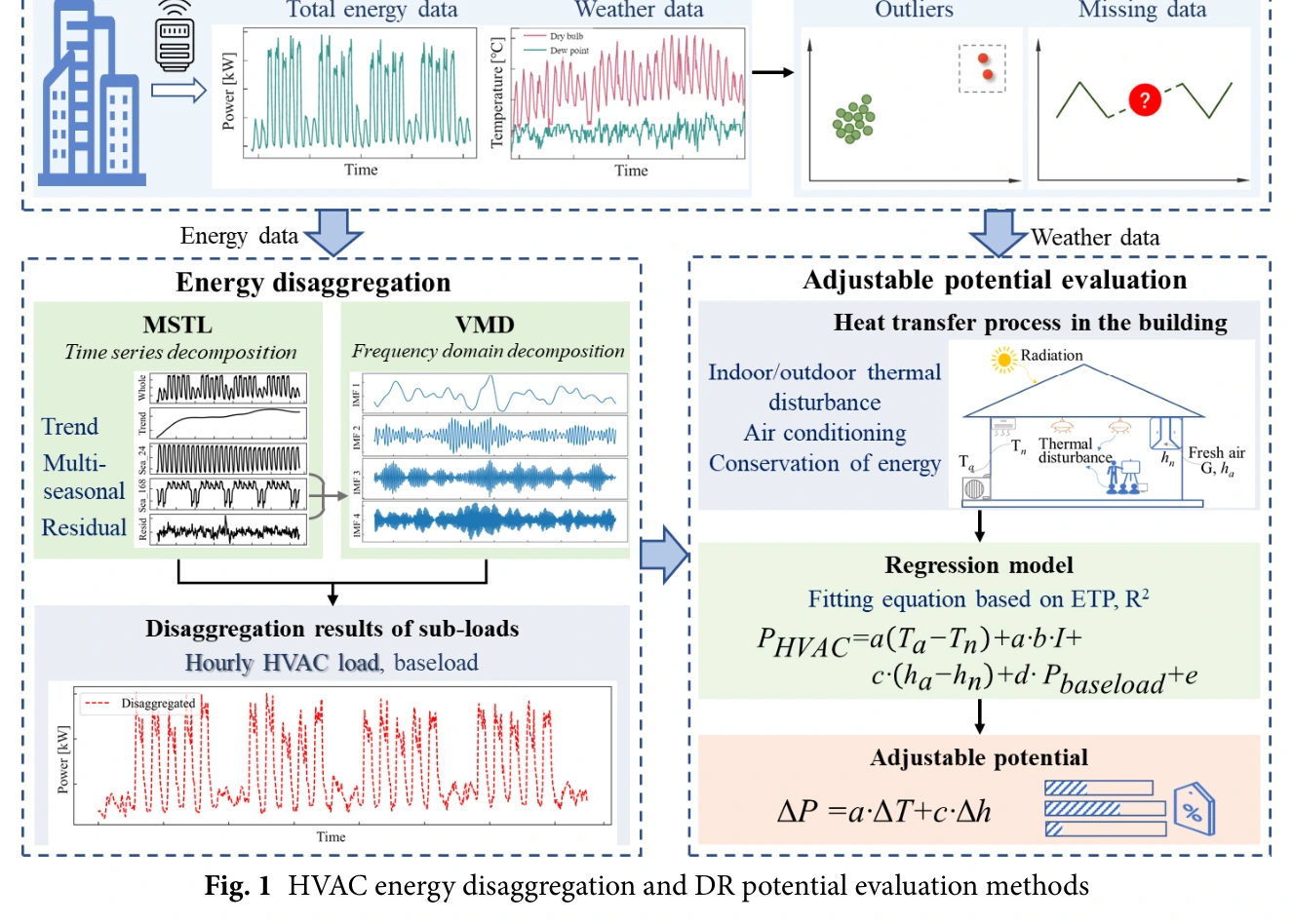
The heating, ventilation, and air conditioning (HVAC) system is a promising flexibility resource for building energy management and grid stability. Quantitatively assessing HVAC demand response (DR) potential is crucial for integrating buildings into DR programs. However, utilities and load aggregators typically only have total building energy data, making HVAC energy disaggregation challenging. This study proposes an unsupervised and hybrid time-frequency domain decomposition method (MSTL-VMD) to disaggregate HVAC energy from total consumption and an improved equivalent thermal parameter model to quantify DR potential while considering outdoor weather, indoor environment, and occupant comfort. The effectiveness of the proposed method is verified based on historical data from 10 office buildings over 3 years. The results indicate that the HVAC energy can be accurately disaggregated using the MSTL-VMD method with NRMSE of 2.4%-12.6%. The proposed equivalent thermal parameter model can realize HVAC energy regression with an R2 value exceeding 0.8 for 80% of cases. A 1 degrees C indoor temperature increase results in energy savings of 7.3%-18.4% over the summer. The proposed method provides utilities and load aggregators with an effective and practical technique to quantify HVAC DR potential, enabling the development of optimal energy management strategies to enhance energy system resilience and efficiency.
Utilities often possess only whole-building energy data, making it difficult to isolate HVAC demand and estimate demand-response flexibility.
An unsupervised MSTL-VMD time-frequency decomposition is paired with an improved equivalent thermal-parameter model for demand-response potential estimation.
Using three years of data from 10 office buildings, the reported HVAC-disaggregation NRMSE ranges from 2.4% to 12.6%; 80% of regression cases exceed R² = 0.8, and a 1°C indoor-temperature increase yields 7.3%–18.4% summer energy savings.
The paper links unsupervised load disaggregation directly to operational flexibility assessment.
Zhang, Ying; Li, Ji; Gang, Wenjie; Dong, Shukun; Hao, Xiuxia; Tu, Zhengkai. An unsupervised method of HVAC energy disaggregation and demand response potential estimation. Building Simulation , 2025, 18, 3317–3335. https://doi.org/10.1007/s12273-025-1367-y
Use the DOI record as the primary source for formal scholarly citation.