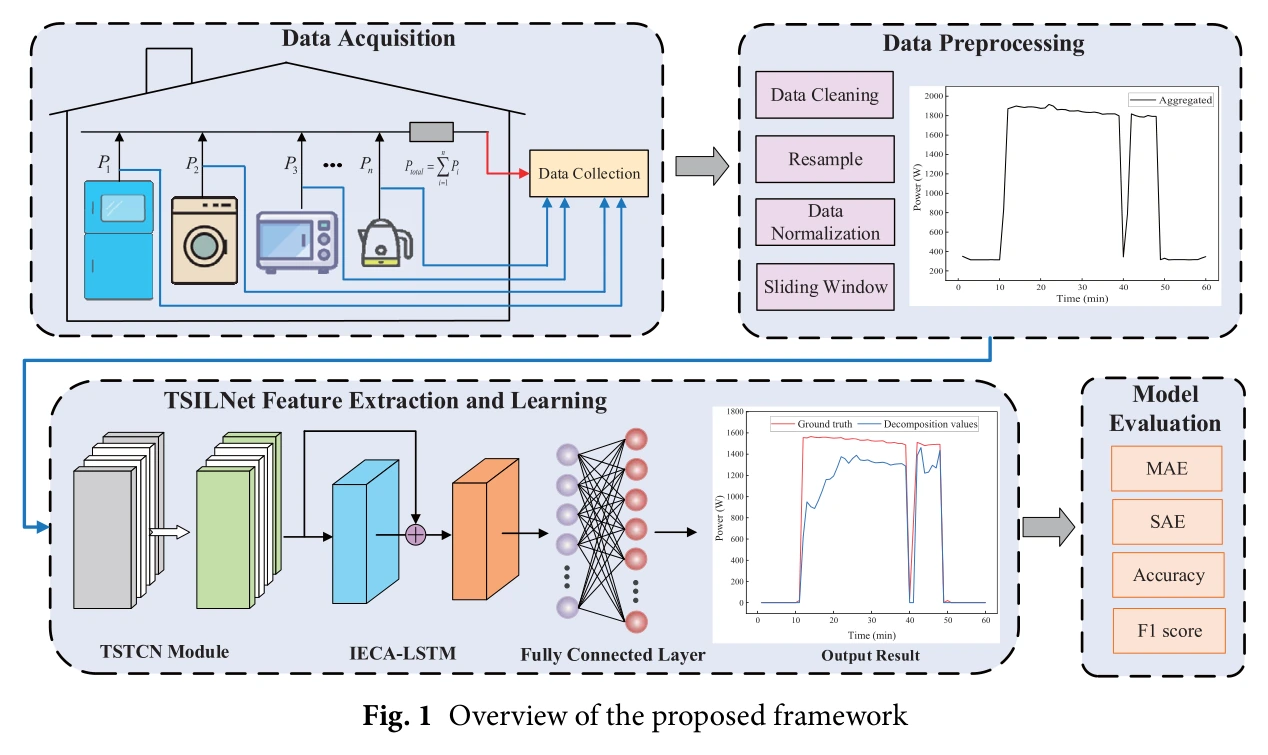
TSILNet: A novel hybrid model for energy disaggregation based on two-stage improved TCN combined with IECA-LSTM
The study provides a hybrid deep-learning route for energy disaggregation and appliance-level load tracking.
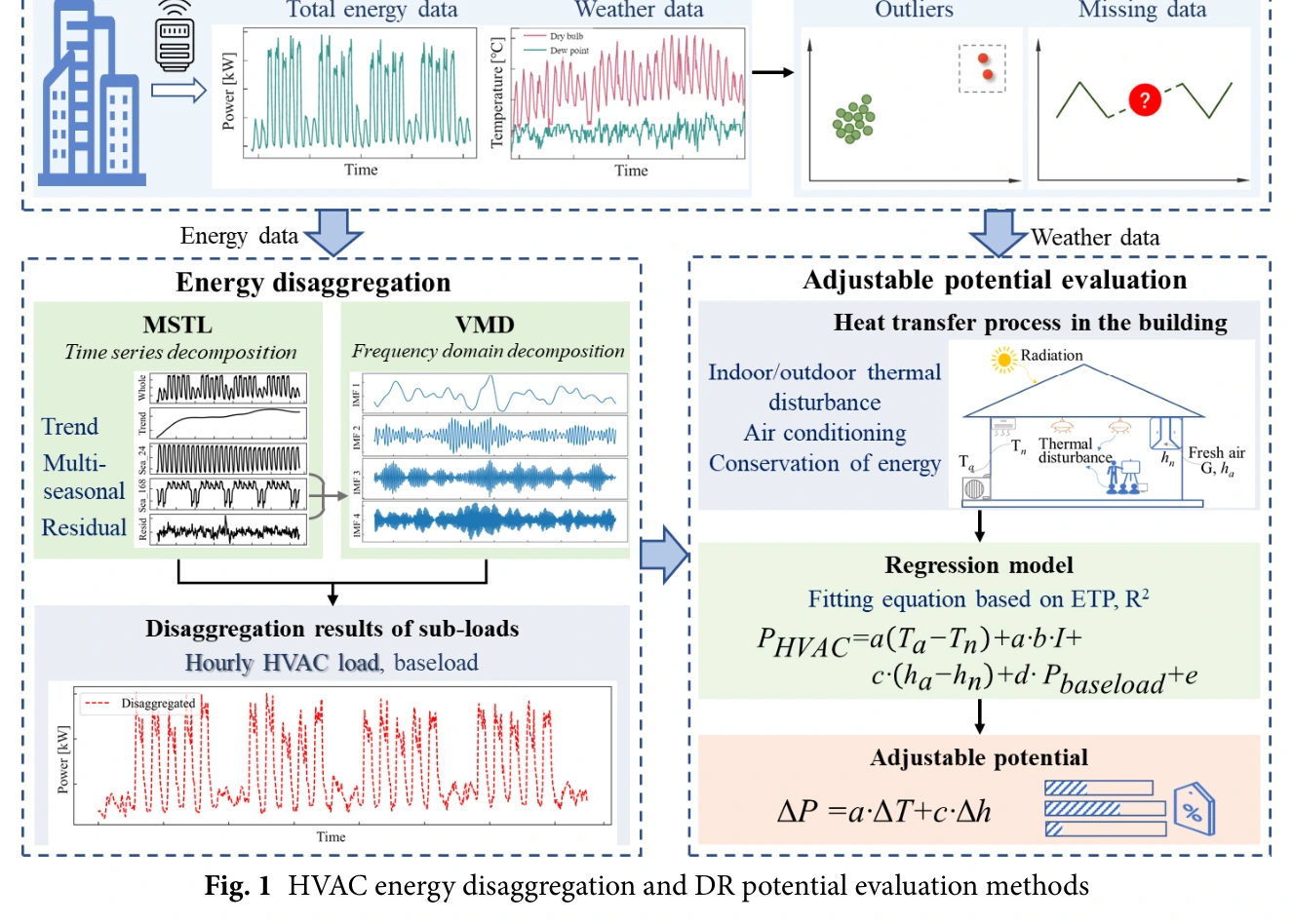
The selected studies cover supervised deep-learning disaggregation at appliance level and unsupervised HVAC disaggregation at whole-building level. The first emphasizes temporal representation learning; the second connects disaggregated HVAC demand to flexibility and demand-response estimation.
| Paper | Research problem | Method | Reported evidence |
|---|---|---|---|
| Zhu et al. (2024) | Non-intrusive load monitoring must recover appliance-level demand from aggregate household signals despite nonlinear and long-range temporal dependencies. | TSILNet combines a two-stage improved temporal convolutional network, an improved efficient channel-attention mechanism, skip connections, and LSTM sequence modeling. | On REDD and UK-DALE, the abstract reports an average 18.67% reduction in MAE and a 38.70% improvement in F1 score across appliances. |
| Zhang et al. (2025) | Utilities often possess only whole-building energy data, making it difficult to isolate HVAC demand and estimate demand-response flexibility. | An unsupervised MSTL-VMD time-frequency decomposition is paired with an improved equivalent thermal-parameter model for demand-response potential estimation. | Using three years of data from 10 office buildings, the reported HVAC-disaggregation NRMSE ranges from 2.4% to 12.6%; 80% of regression cases exceed R² = 0.8, and a 1°C indoor-temperature increase yields 7.3%–18.4% summer energy savings. |
The study provides a hybrid deep-learning route for energy disaggregation and appliance-level load tracking.
The paper links unsupervised load disaggregation directly to operational flexibility assessment.