Research problem
Day-ahead scheduling of buildings and EVs must manage demand response, thermal inertia, uncertainty, and carbon-related objectives.
The work links building thermal flexibility, EV aggregation, market interaction, and distributionally robust optimization.
Authors: Zhao, Bingxu; Cao, Xiaodong; Zhang, Shicong; Ren, Jianlin; Li, Jiayu
Journal: Building Simulation, 2025, volume 18, issue 2, pages 339–352
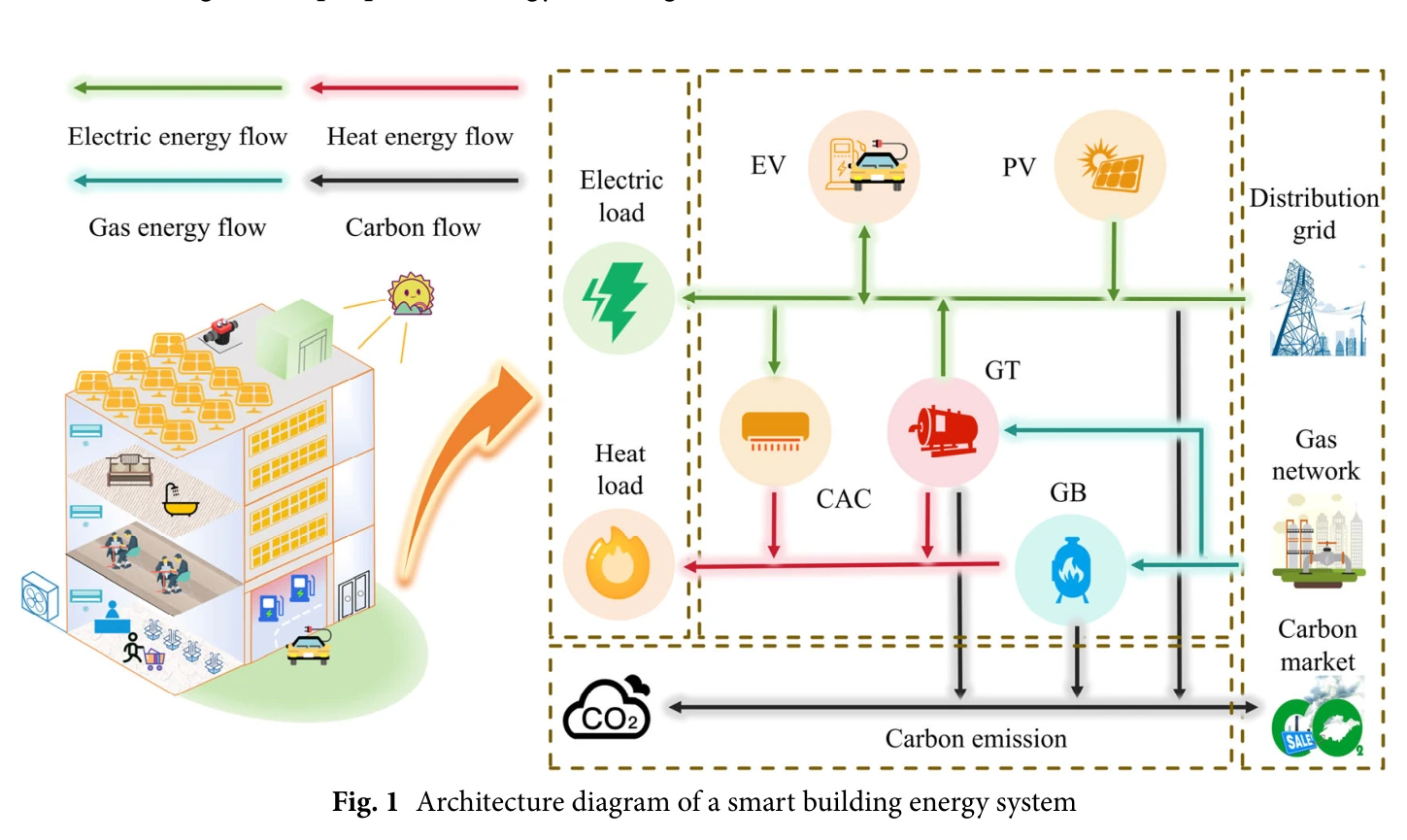
With the adjustment of the energy structure and the rapid development of commercial complex buildings, building energy systems (BES) are playing an increasingly important role. To fully utilize smart building management techniques for coordinating and optimizing energy systems while limiting carbon emissions, this study proposes a smart building energy scheduling method based on distributionally robust optimization (DRO). First, a framework for day-ahead market interaction between the distribution grid (DG), buildings, and electric vehicles (EVs) is established. Based on the the price elasticity matrix principle, demand side management (DSM) technology is used to model the price-based demand response (PBDR) of building electricity load. Meanwhile, the thermal inertia and thermal load flexibility of the building heating system are utilized to leverage the energy storage capabilities of the heating system. Second, a Wasserstein DRO Stackelberg game model is constructed with the objective of maximizing the benefits for both buildings and EVs. This Wasserstein distributionally robust model is then transformed into a mixed-integer model by combining the Karush-Kuhn-Tucker (KKT) conditions and duality theory. Finally, the optimization effect of temperature load storage characteristics on BES flexible scheduling and the coordination of DRO indicators on the optimization results were verified through simulations. The strategy proposed in this article can reduce the total operating cost of BES by 26.37%, significantly enhancing economic efficiency and achieving electricity and heat substitution, resulting in a smoother load curve. This study provides a theoretical foundation and assurance for optimal daily energy scheduling of BES.
Day-ahead scheduling of buildings and EVs must manage demand response, thermal inertia, uncertainty, and carbon-related objectives.
The study formulates price-based demand response and thermal storage, then solves a Wasserstein distributionally robust Stackelberg game through KKT and duality transformations.
The proposed strategy reduces total building-energy-system operating cost by 26.37% in the reported simulations and smooths the load curve.
The work links building thermal flexibility, EV aggregation, market interaction, and distributionally robust optimization.
Zhao, Bingxu; Cao, Xiaodong; Zhang, Shicong; Ren, Jianlin; Li, Jiayu. Day-ahead energy management of a smart building energy system aggregated with electrical vehicles based on distributionally robust optimization. Building Simulation , 2025, 18, 339–352. https://doi.org/10.1007/s12273-024-1219-1
Use the DOI record as the primary source for formal scholarly citation.