Research problem
Non-intrusive load monitoring must recover appliance-level demand from aggregate household signals despite nonlinear and long-range temporal dependencies.
The study provides a hybrid deep-learning route for energy disaggregation and appliance-level load tracking.
Authors: Zhu, Ziwei; Zhou, Mengran; Hu, Feng; Wang, Kun; Zhou, Guangyao; Kong, Weile; Hu, Yijie; Cui, Enhan
Journal: Building Simulation, 2024, volume 17, issue 11, pages 2083–2095
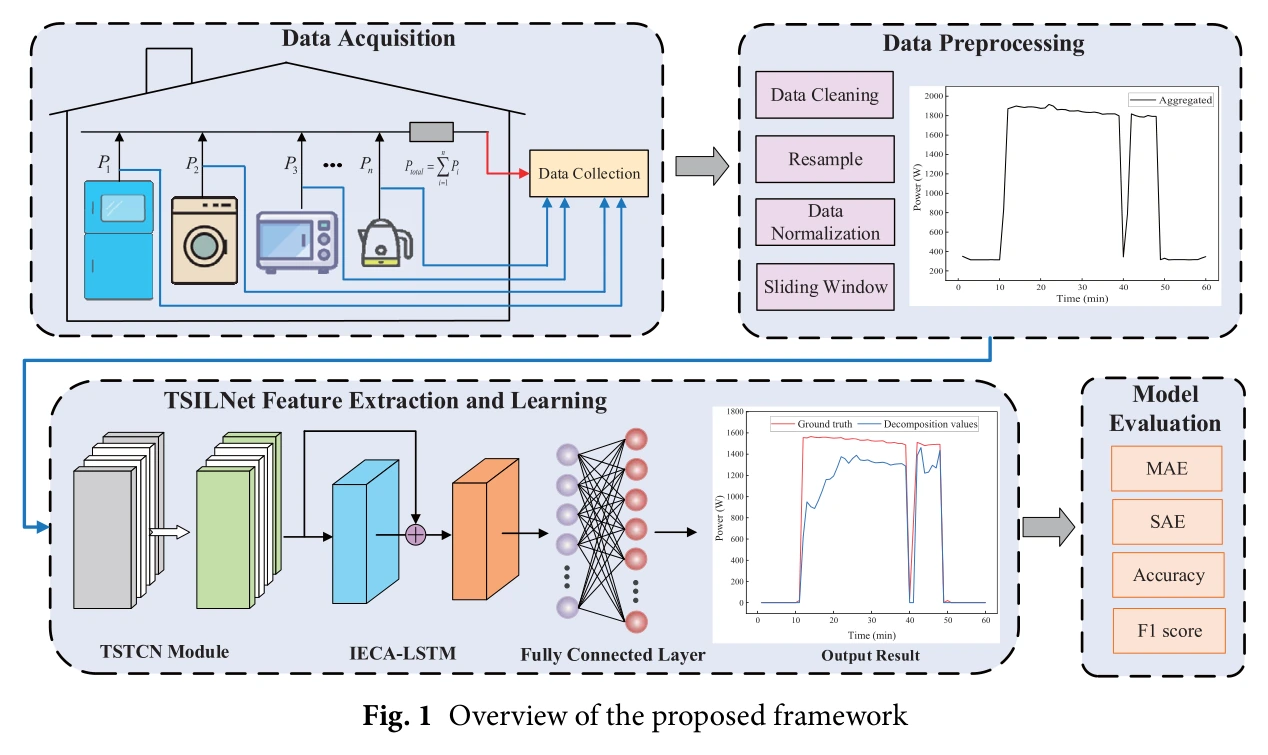
Non-intrusive load monitoring (NILM) technology aims to infer the operation information of electrical appliances from the total household load signals, which is of great significance for energy conservation and planning. However, existing methods are difficult to effectively capture the complex nonlinear features of the power consumption flow, which affects the energy disaggregation accuracy. To this end, this paper designs a method based on temporal convolutional network (TCN), efficient channel attention (ECA), and long short-term memory (LSTM). The method first creatively proposes a two-stage improved TCN (TSTCN), which overcomes its problems of extracting discontinuous information and poor correlation of long-distance information while enhancing the ability to extract high-level load features. Then a novel improved ECA attention mechanism (IECA) is embedded, which is also combined with the skip connection technique to pay channel-weighted attention to important feature maps and promote information fusion. Finally, the LSTM with strong temporal memory capability is introduced to learn the dependencies in the load power sequence and realize load disaggregation. Experiments on two real-world datasets, REDD and UK-DALE, show that the proposed model significantly outperforms other comparative NILM algorithms and achieves satisfactory tracking with the actual appliance operating power. The results show that the mean absolute error (MAE) of all appliances decreases by 18.67% on average, and the F1 score improves by 38.70%.
Non-intrusive load monitoring must recover appliance-level demand from aggregate household signals despite nonlinear and long-range temporal dependencies.
TSILNet combines a two-stage improved temporal convolutional network, an improved efficient channel-attention mechanism, skip connections, and LSTM sequence modeling.
On REDD and UK-DALE, the abstract reports an average 18.67% reduction in MAE and a 38.70% improvement in F1 score across appliances.
The study provides a hybrid deep-learning route for energy disaggregation and appliance-level load tracking.
Zhu, Ziwei; Zhou, Mengran; Hu, Feng; Wang, Kun; Zhou, Guangyao; Kong, Weile; Hu, Yijie; Cui, Enhan. TSILNet: A novel hybrid model for energy disaggregation based on two-stage improved TCN combined with IECA-LSTM. Building Simulation , 2024, 17, 2083–2095. https://doi.org/10.1007/s12273-024-1175-9
Use the DOI record as the primary source for formal scholarly citation.