Research problem
High-inertia thermally activated building systems are difficult to control when key disturbances such as occupancy and solar irradiance are stochastic or unmeasured.
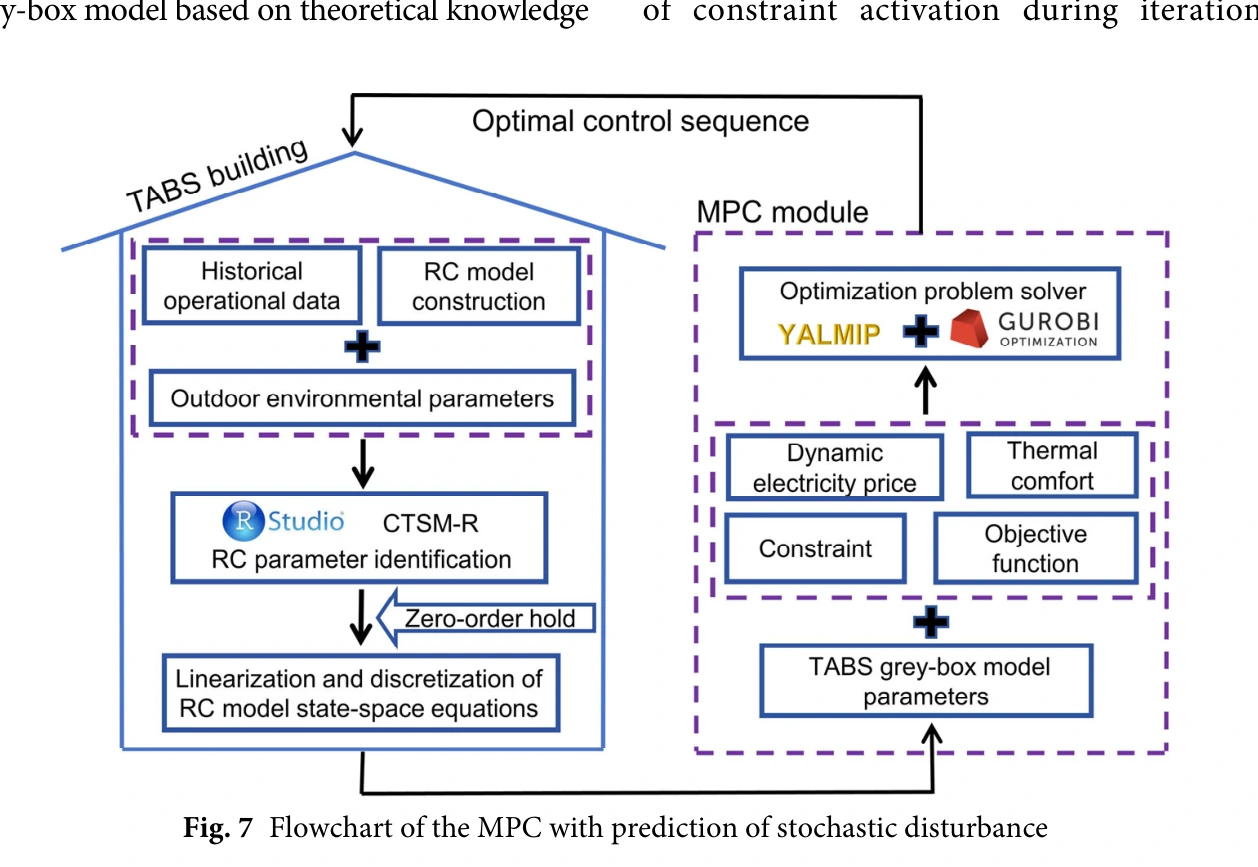
The paper integrates physics-based dynamics, data-driven disturbance prediction, and predictive control.
Authors: Yang, Xiaochen; Lian, Xiaoke; Zhang, Zhenya; Wang, Ping; Ma, Shuo
Journal: Building Simulation, 2025, volume 18, issue 10, pages 2677–2695
Thermally activated building system (TABS) embeds heat exchanging tubes inside the building structure. The high thermal inertia possesses significant energy flexibility potential but also results in challenges for effective control, especially for the situations with unmeasurable stochastic thermal disturbances. This study presents an innovative hybrid model predictive control (MPC) framework that synergistically combines grey-box modeling with neural network-based disturbance prediction, specifically designed to overcome the control challenges of high-thermal-inertia TABS subject to unmeasurable stochastic disturbances. The framework is validated by experimental tests and supports both single and multiple disturbance scenarios. Concerning occupancy and outdoor solar global irradiance as the key stochastic disturbances, different control strategies including the rule-based control (RBC), conventional MPC without disturbance prediction, MPC with single disturbance prediction, MPC with multiple disturbances prediction, are established and systematically compared. Performance metrics including the temperature regulation accuracy, energy consumption, operation cost, and energy flexibility are quantitatively investigated. The results demonstrate that all MPC strategies outperform RBC. Compared to conventional MPC, the disturbance-prediction-coupled MPC reduces temperature constraint violations by 20%-42%, achieves 6% cost savings, and improves energy flexibility by 3.1%-8.6%. The multi-disturbance prediction MPC shows optimal performance in temperature control, cost savings and energy flexibility enhancement. The proposed framework improves the accuracy of building load forecasting and the control performance of high thermal inertia systems, providing a pathway for optimizing building energy consumption and the coordinated operation efficiency of renewable energy in practical engineering applications.
High-inertia thermally activated building systems are difficult to control when key disturbances such as occupancy and solar irradiance are stochastic or unmeasured.
A hybrid MPC framework combines grey-box system modeling with neural-network disturbance forecasting and compares no-, single-, and multi-disturbance prediction strategies.
Relative to conventional MPC, disturbance-aware MPC reduces temperature violations by 20%–42%, cuts cost by 6%, and improves energy flexibility by 3.1%–8.6%.
The paper integrates physics-based dynamics, data-driven disturbance prediction, and predictive control.
Yang, Xiaochen; Lian, Xiaoke; Zhang, Zhenya; Wang, Ping; Ma, Shuo. Hybrid physics-neural-network MPC with stochastic disturbance forecasting for high-inertia thermally activated building systems. Building Simulation , 2025, 18, 2677–2695. https://doi.org/10.1007/s12273-025-1338-3
Use the DOI record as the primary source for formal scholarly citation.